For many people moving to the Atlanta area, the dream isn’t necessarily a large subdivision with a neighborhood pool and houses sitting close together. Some buyers want something different: a home with room to breathe, a wooded property with a long driveway, space for a garden, a few acres for horses, or simply enough land to enjoy some privacy.
The good news is that larger lots can still be found around Atlanta. The search just tends to move beyond the city’s most densely developed neighborhoods and into communities where residential properties have historically included more land.
If you’re looking for acreage near Atlanta, several areas deserve a closer look, including Milton, Cherokee County, Forsyth County, Fayette County, Coweta County, Douglas County, Paulding County, and Henry County. Each offers a different combination of land, housing, commute times, and lifestyle.
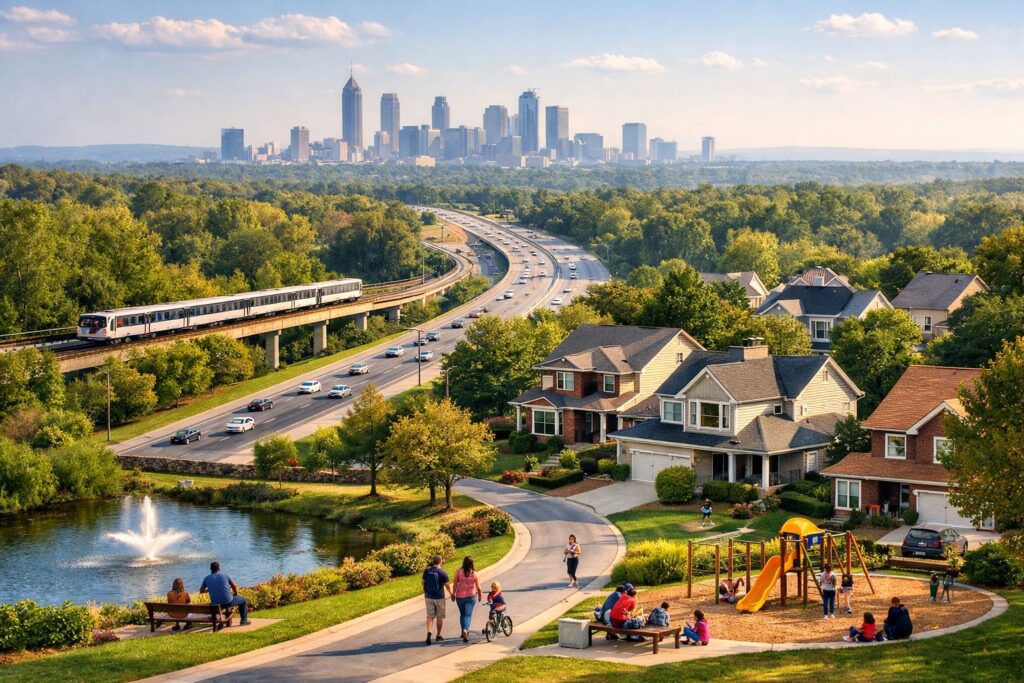
image generated by Gemini
Why Larger Lots Are Becoming Harder to Find
Atlanta has experienced substantial growth, and many areas that once had open fields and large properties have gradually been developed into residential communities.
That makes acreage increasingly valuable. Older properties with several acres may be surrounded by newer subdivisions, while undeveloped parcels can attract buyers who want to build a custom home rather than purchase an existing property.
Historical Atlanta-area land data also shows a clear pattern: larger residential parcels have generally been more common in counties farther from the urban core. A Georgia Tech/University of British Columbia study found substantially larger average single-family residential parcel sizes in counties such as Henry, Fayette, Coweta, Douglas, and Cherokee compared with Fulton and Gwinnett.
In other words, buyers looking for several acres may have better luck expanding the search beyond Atlanta’s inner suburbs.
Milton: Upscale Homes and Open Space
Milton is one of the first places many buyers consider when they want acreage without giving up an upscale suburban lifestyle.
Located in North Fulton County, Milton is known for large homes, equestrian properties, wooded land, and spacious residential settings. Some properties feature several acres rather than the smaller lots commonly found in newer subdivisions.
The trade-off is price. Land in desirable North Fulton communities can command a premium because buyers aren’t simply paying for acreage. They’re also paying for location, schools, established neighborhoods, and access to employment and shopping centers.
For someone who wants a large lot while remaining close to Alpharetta and other major North Atlanta destinations, Milton can be particularly attractive.
Cherokee County: More Land and a Variety of Settings
Cherokee County is another strong option for buyers searching for acreage near Atlanta.
The county includes communities such as Canton, Woodstock, Ball Ground, and Waleska, giving buyers a range of environments. The farther north you travel, the easier it can be to find properties with a more rural appearance.
Current land listings illustrate the variety available. Properties ranging from a few acres to much larger tracts are regularly marketed in areas around Canton and Ball Ground.
Cherokee County can be a good compromise for someone who wants substantial land but still wants access to shopping, restaurants, schools, and major roads.
Why Consider Cherokee County?
Larger residential lots are available
Wooded properties are common
Several established communities offer suburban conveniences
Northern portions have a more rural atmosphere
Access to I-575 makes commuting more practical for many residents
Buyers should still check zoning and development restrictions on individual parcels, particularly if they have plans for animals, outbuildings, workshops, or additional structures.
Forsyth County: Acreage in a Fast-Growing Area
Forsyth County has become one of the most sought-after areas north of Atlanta, particularly around Cumming and the communities surrounding Lake Lanier.
Although significant development has taken place, larger properties can still be found, particularly outside the most heavily developed corridors.
The challenge is that demand is high. Buyers searching for several acres in Forsyth County may find that properties with desirable locations, good road access, and attractive homes come with substantial price tags.
For families who want land but don’t want to move too far from North Atlanta’s employment and commercial centers, however, Forsyth remains worth investigating.
Fayette County: Space South of Atlanta
For buyers willing to look south of the city, Fayette County offers another interesting combination of acreage and suburban convenience.
Communities such as Fayetteville, Peachtree City, and Tyrone provide different versions of suburban living, while less-developed areas can offer properties with considerably more land.
Fayette County has historically had larger residential parcels than the urban core. A Georgia land-use analysis found Fayette among the Atlanta-area counties with some of the largest average single-family residential parcel sizes.
The area can be particularly appealing to buyers who want:
More privacy
Larger yards
Mature trees
Space for gardens
Room for recreational activities
A quieter residential environment
One consideration is that acreage doesn’t automatically mean unrestricted use. Before purchasing, investigate zoning, septic requirements, easements, road frontage, and local development regulations.
Coweta County: Acreage With a More Rural Feel
Coweta County, including communities such as Newnan and Sharpsburg, is worth considering if your idea of Atlanta-area living includes a little more breathing room.
Coweta combines growing suburban communities with areas that still have farmland, wooded properties, and larger residential parcels.
Its location southwest of Atlanta also gives buyers an alternative to the increasingly expensive northern suburbs.
For people who work in Atlanta but don’t necessarily need to live close to the city center, Coweta can provide a different lifestyle—one where owning several acres is more realistic.
The county’s average single-family parcel size has historically been considerably larger than that of Fulton or Gwinnett, according to Atlanta-area parcel research.
Douglas County: A Practical Choice for West Atlanta
If you want acreage while staying reasonably close to Atlanta, Douglas County deserves attention.
Communities such as Douglasville and surrounding areas can offer larger properties while maintaining access to I-20 and the western side of the metro area.
Douglas County is particularly interesting for buyers who don’t need the prestige or price level associated with some North Atlanta acreage markets. Current real estate analysis points to the county as an area where one-to-ten-acre properties can still be found, depending on location and development.
For commuters heading toward downtown Atlanta or western employment centers, the location can make Douglas County a practical middle ground between suburban living and rural space.
Paulding County: More Space for the Money
Paulding County is another area to investigate if acreage is high on your priority list.
Centered around communities such as Dallas and Hiram, Paulding has experienced significant growth while retaining large areas of undeveloped land and open space.
The county’s comprehensive planning documents note that more than 40,000 acres of its land area is open greenspace, along with extensive recreational resources.
This doesn’t mean every property has acreage, but it helps explain why the landscape can feel considerably less dense than neighborhoods closer to Atlanta.
Paulding can be especially appealing to buyers who prioritize land over proximity to downtown.
The farther you move toward the outer portions of the county, the more important the daily commute becomes. A property that looks like a bargain may feel very different after several months of driving to work.
Henry County: Larger Properties South of Atlanta
Henry County provides another option for buyers searching south of Atlanta.
Communities such as McDonough, Locust Grove, and Stockbridge offer a range of housing options, and larger parcels can be found farther away from the most developed corridors.
Historical parcel data places Henry County among the Atlanta-area counties with particularly large residential parcels.
For buyers who want land and easy access to I-75, the southern metro area can make sense.
It’s also worth comparing different parts of Henry County rather than treating the county as one market. Property size, neighborhood development, commute times, and surrounding land uses can vary significantly.
What About Cobb County?
Cobb County is convenient, established, and highly desirable, but finding large residential lots can be more difficult than in some outer-ring counties.
That doesn’t mean acreage doesn’t exist. Properties with several acres can still be found, particularly around less-developed portions of the county and near communities such as Powder Springs and parts of West Cobb.
However, buyers should expect competition for properties that combine acreage with a convenient location.
If your priority is five or more acres, expanding the search into Douglas, Paulding, Cherokee, or other nearby counties may produce more options.
How Much Land Do You Really Need?
Before starting your search, decide what “large lot” actually means to you.
A quarter-acre lot may feel spacious compared with an urban townhouse, but it won’t provide the same experience as one acre. Likewise, five acres is very different from twenty acres.
Think about what you want to do with the property.
One to Two Acres
This may be enough if your goal is:
A larger backyard
More privacy
A garden
Outdoor entertaining
A detached garage or workshop
Three to Five Acres
This provides substantially more flexibility and can work well for buyers who want:
More privacy
Trails
Gardens
Recreational space
Small livestock, where permitted
Larger outbuildings
Ten Acres or More
At this point, you’re moving into a different type of property.
Large tracts can provide serious privacy and agricultural or recreational opportunities, but they also require more consideration regarding maintenance, access, fencing, drainage, utilities, and property taxes.
Don’t Buy Acreage Without Checking These Things
A beautiful property can become an expensive mistake if you only look at the house and acreage.
Before making an offer, investigate the land itself.
Zoning
Find out exactly how the property is zoned and what activities are permitted.
Don’t assume that owning five acres automatically means you can build whatever you want.
Septic and Sewer
Some acreage properties aren’t connected to public sewer systems.
If the property uses septic, have the system evaluated and determine whether the soil and site can support the intended use.
Road Access
A long private driveway may look appealing, but it can create additional maintenance responsibilities.
Check who owns the road, who maintains it, and whether there are recorded access easements.
Flood Zones and Drainage
A property can contain considerably less usable land than its advertised acreage suggests.
Streams, wetlands, steep slopes, flood zones, and drainage issues can limit where you can build.
Utilities
Determine whether water, electricity, natural gas, and other utilities are already available.
Running utilities to a remote portion of a large parcel can become surprisingly expensive.
Property Restrictions
Check for HOA rules, conservation easements, deed restrictions, and other limitations.
This is particularly important if you are purchasing land for a custom home, hobby farm, workshop, animals, or future development.
Finding the Right Balance Between Land and Location
The biggest decision for an acreage buyer around Atlanta is usually not simply how much land to buy.
It’s how far you’re willing to live from everything else.
A five-acre property in Milton can offer a very different lifestyle from a five-acre property in Paulding County. Both may provide privacy, but the commute, shopping options, schools, home prices, and surrounding development can be completely different.
That’s why it helps to divide the Atlanta metro into broad search areas.
North Atlanta: Milton, Cherokee County, Forsyth County
West Atlanta: Douglas County, Paulding County, West Cobb
South Atlanta: Fayette County, Coweta County, Henry County
From there, narrow the search based on your workplace, budget, desired amount of land, and preferred lifestyle.
Is Buying Acreage Near Atlanta Worth It?
For the right buyer, absolutely.
A larger lot can provide something that is becoming increasingly difficult to find around a growing metropolitan area: privacy and personal space.
You can have a larger garden, create outdoor living areas, keep more distance from neighbors, enjoy wooded surroundings, or simply have enough room for the property to feel like your own private retreat.
The key is understanding that acreage comes with trade-offs. Larger properties may require more maintenance, longer driveways, private wells or septic systems, and longer commutes.
For many Atlanta-area buyers, though, that trade-off is exactly what makes the search worthwhile.
Finding acreage around Atlanta requires looking beyond the traditional list of popular suburbs.
Milton and North Fulton can be appealing for buyers seeking upscale acreage close to major amenities. Cherokee and Forsyth counties offer larger properties farther north, while Fayette and Coweta counties provide spacious alternatives south and southwest of the city. Douglas and Paulding counties can be attractive to buyers who want more land without moving extremely far from Atlanta. Henry County is another option for those considering the southern metro area.
There isn’t one perfect location for everyone. The best place to buy acreage depends on how much land you need, how much you’re comfortable spending, where you work, and what you actually plan to do with the property.
Start with those priorities, then compare individual parcels carefully. When you find the right combination of land, location, and lifestyle, owning a larger property near Atlanta can offer a level of space and privacy that’s difficult to replicate in a typical subdivision.
The written content on this page was generated by ChatGPT.
Buying a home in the Atlanta area can be about much more than finding a property you like today. For many buyers, the bigger question is what that home could be worth five, 10, or even 15 years from now. Location, neighborhood character, employment centers, schools, transportation, new development, and housing demand can all influence long-term property values.
That makes ZIP code an important starting point when comparing Atlanta-area real estate. A ZIP code does not guarantee appreciation, but it can reveal broader patterns in a community and help buyers narrow down locations worth researching.
As of 2026, several Atlanta ZIP codes stand out because of their combination of desirable locations, established neighborhoods, amenities, strong demand, or potential for continued development.
image generated by Gemini
What Makes an Atlanta ZIP Code Attractive for Long-Term Growth?
Before looking at individual ZIP codes, it helps to understand what tends to support property appreciation.
The strongest locations often have several advantages working together. Proximity to major employment centers can make an area attractive to professionals, while highly regarded schools can increase demand from families. Convenient access to highways and transit can also expand the pool of potential buyers.
Neighborhood amenities matter as well. Walkable shopping districts, restaurants, parks, trails, entertainment, and community spaces can make an area more desirable over time.
Another factor is supply. Established neighborhoods with limited opportunities for new single-family construction can benefit when demand continues to rise. Conversely, areas with large amounts of new inventory may experience a different appreciation pattern.
Atlanta’s diverse housing market means there is no single formula for identifying the next high-growth ZIP code. Buyers should look at several indicators rather than relying on a recent one-year price change.
30327: Luxury Property and Established Atlanta Demand
ZIP code 30327 covers portions of northwest Atlanta, including areas around Chastain Park and Tuxedo Park. It is one of the metro area’s most expensive residential ZIP codes and has a reputation for large homes, spacious properties, established neighborhoods, and access to desirable amenities.
Zillow reported a typical home value of approximately $1.57 million in 30327 as of June 2026, with values up 4.8% over the preceding year. Redfin’s data showed an even stronger recent movement in median sale prices, although the two services use different methodologies and time periods.
The ZIP code’s appeal is not based on affordability. Instead, its long-term attraction comes from scarcity, prestige, location, and continued demand for high-end Atlanta real estate.
For buyers focused on preserving value in the luxury segment, 30327 deserves attention.
30342: A Strong North Atlanta Location
ZIP code 30342 includes parts of Sandy Springs and north Atlanta, placing residents near Buckhead, major roads, shopping, medical facilities, offices, and other established employment centers.
The ZIP code’s typical home value was approximately $855,000 in June 2026 according to Zillow data cited in current market reports.
One reason 30342 can be attractive for long-term ownership is its location. Properties that provide convenient access to multiple parts of the metro area can remain desirable even as Atlanta continues to grow.
Recent Buckhead-area market data also showed strong 2026 performance in 30342, with year-to-date median sold prices increasing substantially compared with the previous year.
30319: Brookhaven’s Mix of Convenience and Desirability
Brookhaven has become one of the most recognizable communities in the Atlanta metro area, and ZIP code 30319 offers a combination of established neighborhoods and convenient access to major employment and entertainment areas.
The ZIP code has a wide variety of housing, from older homes to newer construction and townhome developments. That variety can appeal to different types of buyers.
Current Zillow-based data places the typical value in 30319 at roughly $780,000, making it one of the higher-value ZIP codes in the Atlanta region.
Its location between Atlanta and northern suburbs is one of its biggest advantages. Buyers who want suburban-style neighborhoods without giving up easy access to the city may continue to find 30319 attractive.
30306: Established Intown Appeal
For buyers interested in long-term property value within Atlanta’s urban core, 30306 is worth watching.
The ZIP code includes areas such as Virginia-Highland and Morningside, where older homes, mature trees, local businesses, restaurants, and proximity to parks contribute to the area’s character.
Zillow’s June 2026 data placed the typical home value in 30306 at approximately $964,000.
Established intown neighborhoods can have an advantage because their identity is already well developed. There is less dependence on a future master-planned community becoming successful.
For buyers who value walkability, historic architecture, neighborhood businesses, and proximity to central Atlanta, 30306 can offer a compelling long-term ownership profile.
30307: Character, Location, and Intown Demand
ZIP code 30307 includes neighborhoods such as Candler Park and areas near Little Five Points. It has a distinctly Atlanta feel, with older housing, local businesses, parks, and access to major intown destinations.
Zillow data cited in current Atlanta market information places the typical home value around $744,000.
The appeal of 30307 comes partly from its limited suburban-style feel. Buyers looking for character and proximity to the city’s core may continue to compete for properties in established neighborhoods.
Homes with desirable lots, strong curb appeal, functional layouts, and good access to neighborhood amenities may have particularly strong resale potential.
30318: A ZIP Code to Watch for Continued Development
ZIP code 30318 covers a large section of west and northwest Atlanta and includes areas associated with West Midtown and the Westside.
This ZIP code is particularly interesting because it combines established residential neighborhoods with ongoing redevelopment and new construction.
Current Zillow data shows a typical 30318 home value of approximately $384,000, while Realtor.com reported a median listing price of about $415,000 in its latest available ZIP-code data.
The area has experienced significant investment over the years, especially around West Midtown and Atlanta’s western neighborhoods. New restaurants, offices, apartments, retail, and mixed-use projects can change the perception of an area and potentially influence surrounding residential demand.
That does not mean every property in 30318 will appreciate equally. Buyers should research the specific neighborhood, street, development pipeline, and property type before purchasing.
Still, for investors and homeowners looking for an Atlanta ZIP code with a mixture of established neighborhoods and ongoing transformation, 30318 is an area worth investigating.
30317: East Atlanta’s Established Neighborhood Appeal
ZIP code 30317 includes East Lake and Kirkwood, two communities that have benefited from Atlanta’s broader intown revitalization.
Zillow data cited in current market information puts the typical value around $575,000.
The area appeals to buyers who want a neighborhood environment while remaining close to central Atlanta. Older houses, renovated properties, local restaurants, parks, and access to nearby communities contribute to its appeal.
Long-term buyers should pay attention to individual streets and property condition. In older Atlanta neighborhoods, the difference between a well-maintained home in a desirable section and a property requiring extensive work can be significant.
30324: Convenient Intown Location
ZIP code 30324 covers areas around Lindbergh and Piedmont Heights and provides relatively convenient access to Buckhead, Midtown, major roads, shopping, and employment centers.
Realtor.com recently reported a median listing price of about $365,000 for 30324, while Zillow’s broader home-value data places the typical value considerably higher depending on the property mix being measured.
The important takeaway is that ZIP-code averages can hide major differences between condos, townhomes, and detached houses.
For long-term appreciation, buyers should compare similar property types rather than simply comparing the average price of one ZIP code against another.
30004: Alpharetta’s Strong Suburban Market
Moving beyond Atlanta city limits, ZIP code 30004 covers a significant portion of Alpharetta and Milton-area real estate.
It is one of the metro area’s most closely watched suburban ZIP codes because of its schools, employment opportunities, shopping, restaurants, newer communities, and high-quality residential development.
Zillow reported a typical home value of approximately $770,000 in June 2026. Redfin reported a median sale price of about $845,000 for the three months ending May 2026, representing a 6.3% year-over-year increase.
The difference between these figures illustrates why buyers should compare multiple data sources before making an investment decision.
The larger story is Alpharetta’s continued appeal as a major North Fulton employment and residential destination. For buyers seeking a suburban property with long-term demand drivers, 30004 is an important ZIP code to research.
30005: A Top-Ranked ZIP Code for Atlanta-Area Buyers
ZIP code 30005 is another Alpharetta-area location that deserves attention.
Niche’s 2026 ranking of the best ZIP codes to buy a house in the Atlanta area placed 30005 at number one. Its ranking considers factors including housing costs, home values, property taxes, ownership rates, schools, and real estate trends.
A ranking alone should not determine a purchase, but 30005’s combination of residential demand, amenities, schools, and North Fulton location makes it an attractive market to investigate.
For buyers thinking beyond today’s price and considering resale demand years into the future, established suburban communities such as this can be compelling.
30024: Suwanee and the Appeal of Strong Suburban Communities
ZIP code 30024 covers much of Suwanee and surrounding areas in Gwinnett County.
Suwanee has developed a reputation for planned communities, parks, recreation, schools, shopping, and community events. These qualities can help maintain buyer interest as families move throughout the metro area.
The long-term value story here is less about being close to downtown Atlanta and more about creating a complete suburban lifestyle.
That distinction matters. A property does not necessarily need to be in the city center to appreciate. A community that consistently attracts households looking for schools, recreation, space, and amenities can support durable housing demand.
30075: Roswell’s Established Residential Market
ZIP code 30075 covers much of Roswell, a northern suburb known for established neighborhoods, historic areas, parks, trails, and access to both Alpharetta and Atlanta.
Roswell’s location gives residents access to the amenities of North Fulton without requiring them to live in one of the area’s most expensive communities.
For long-term buyers, established suburbs can provide an interesting middle ground between affordability and prestige. Homes in desirable Roswell neighborhoods may attract buyers who want larger properties and suburban amenities while remaining within reach of major employment centers.
How to Choose the Right Atlanta ZIP Code for Long-Term Growth
A ZIP code should be the beginning of your research, not the final decision.
When comparing properties, consider these factors:
Look at Five- and Ten-Year Trends
A single year of appreciation can be misleading. Real estate markets move through cycles, so examine longer periods whenever reliable historical data is available.
Compare Similar Properties
A ZIP code with expensive luxury homes may have a very different appreciation pattern from one dominated by condos or starter homes.
Compare detached homes with detached homes, townhomes with townhomes, and condos with condos.
Research New Development
New restaurants, offices, retail centers, infrastructure improvements, and mixed-use developments can change an area’s appeal.
At the same time, excessive new housing supply can create competition for existing properties.
Pay Attention to Schools and Amenities
Schools, parks, shopping, restaurants, healthcare facilities, and recreational opportunities can influence where buyers want to live.
Consider Transportation
Atlanta’s size makes transportation particularly important. Access to major highways, MARTA stations, employment centers, and key corridors can influence both convenience and resale demand.
Examine the Individual Neighborhood
Two properties in the same ZIP code can perform very differently.
Look at the specific subdivision, street, lot, property condition, surrounding homes, future development, and recent comparable sales.
The best Atlanta ZIP codes for long-term property value growth are not necessarily the cheapest ZIP codes or the ones with the largest one-year price increase.
Locations such as 30327, 30342, 30319, 30306, 30307, 30318, 30317, 30324, 30004, 30005, 30024, and 30075 each offer different investment characteristics.
Some provide luxury-market stability and scarce housing. Others offer established intown neighborhoods, while several North Atlanta suburbs benefit from strong schools, employment opportunities, amenities, and continued residential demand.
The most important step is to look beyond the ZIP code itself. A great long-term property is usually the combination of location, neighborhood quality, property condition, purchase price, and future demand.
Atlanta’s real estate market is large and diverse, which gives buyers plenty of opportunities. Rather than chasing the ZIP code that had the biggest gain last year, focus on communities with characteristics that can continue attracting buyers for years to come, including convenient access to reliable home security solutions and other essential property services.
The written content on this page was generated by ChatGPT.
Ellenwood, Georgia, is one of those Atlanta-area communities that can be easy to overlook when searching for a place to live. Located southeast of Atlanta, the community offers something that many homebuyers find increasingly difficult to get close to a major city: more space, established neighborhoods, mature trees, and relatively convenient access to employment centers. Residents can also benefit from access to essential home security services, such as residential lock installation and key replacement, which can add convenience and peace of mind for homeowners.
For people considering a move to the Atlanta metro area, living in Ellenwood can make sense for families, commuters, first-time buyers, and anyone who prefers a quieter suburban setting without being too far from Atlanta. The area also provides access to shopping, restaurants, parks, major highways, and nearby outdoor destinations.
Here is what prospective residents should know about Ellenwood, GA, before deciding whether it is the right Atlanta suburb for them.
image generated by ChatGPT
Where Is Ellenwood, Georgia?
Ellenwood is an unincorporated community in the southeastern Atlanta metropolitan area, primarily associated with DeKalb County and extending into areas served by Clayton County. Its location puts residents within reach of Atlanta while maintaining a more suburban and residential atmosphere.
Major roads and interstates are an important part of everyday life in the area. Interstate 675 provides a direct connection toward Interstate 285 and other parts of metro Atlanta, while Interstate 20 is also accessible from the community. Downtown Atlanta is roughly 15 miles away by road, although actual travel time can vary substantially depending on traffic.
The community is also relatively close to Hartsfield-Jackson Atlanta International Airport, which can be particularly appealing to frequent travelers and people who work around the airport corridor.
Why Do People Choose to Live in Ellenwood?
The biggest attraction of Ellenwood is its combination of space and metropolitan access.
Unlike some of Atlanta’s more densely developed neighborhoods, Ellenwood has established residential areas where homes can sit on larger lots surrounded by mature trees. Local housing guides describe the community as having a rural or wooded character despite its proximity to Atlanta.
That combination creates a different experience from living in central Atlanta. Instead of being surrounded by high-rise buildings, busy entertainment districts, and dense development, residents can find quieter streets and traditional single-family homes.
For buyers who want Atlanta access but do not necessarily want an urban lifestyle, that can be a significant advantage.
Ellenwood Housing and Real Estate
Housing is one of the main reasons Ellenwood attracts attention from people searching for affordable homes near Atlanta.
The housing stock includes ranch-style homes, split-level properties, Colonial Revival designs, newer traditional homes, and residences on larger lots. Many neighborhoods were established decades ago, giving parts of Ellenwood a mature appearance rather than the look of a recently constructed subdivision.
Real estate conditions change throughout the year, so buyers should always check current listings rather than relying on an old citywide average. As of June 2026, Realtor.com’s market data showed a median listing price of approximately $299,900 and a median sold price of $250,000 in Ellenwood. The same data showed a median rent of about $2,000 per month.
These figures can vary considerably depending on the neighborhood, property size, condition, lot size, and proximity to major roads.
What Kind of Homes Can You Find?
Prospective buyers may encounter:
Traditional single-family houses
Ranch-style homes
Split-level properties
Homes with attached garages
Larger-lot properties
Established subdivision homes
Rental houses and apartment communities
One advantage of shopping in Ellenwood is that buyers may find properties with more land than they would typically receive for the same budget in some closer-in Atlanta neighborhoods.
A Good Choice for Buyers Who Want More Space
For some Atlanta-area homebuyers, the appeal isn’t necessarily having the newest house. It is having room around the house.
Ellenwood’s mature residential areas can provide larger yards, established landscaping, and trees that give neighborhoods a more secluded appearance. Some properties have considerably more land than the tightly packed homes found in newer developments.
That can be especially attractive to people who want outdoor space, gardening areas, room for children to play, or simply more separation from neighboring houses.
Of course, larger lots can also mean more maintenance. Buyers should consider landscaping, roofing, drainage, driveway conditions, septic or sewer arrangements where applicable, and other property-specific expenses during the inspection process.
Schools in and Around Ellenwood
Families considering a move to Ellenwood should pay close attention to school attendance boundaries because the area is served by more than one school system.
Depending on the specific address, students may fall within DeKalb County School District or Clayton County Public Schools. Charter and private-school options are also available in the broader area.
School assignments can change, so prospective homeowners should verify the current attendance zone directly with the appropriate school district before purchasing a property.
This is particularly important because a home that appears to be in Ellenwood may have a different assigned school from another property only a few miles away.
Parks and Outdoor Recreation in Ellenwood
Ellenwood offers several options for residents who enjoy spending time outside.
Village Park – Ellenwood is one of the area’s larger recreational destinations. The park provides opportunities for walking, sports, playground activities, and family recreation.
DeKalb County also lists Ellenwood (Alice White Bussey Legacy) Park, an eight-acre park with recreational facilities including basketball and tennis, as well as Fort Creek Mountain Park on River Road.
Nearby outdoor destinations add even more variety. Residents can reach areas around Panola Mountain for hiking, nature exploration, fishing, and picnicking. DeKalb County’s broader park system includes hundreds of acres of parks, trails, playgrounds, and natural areas.
For someone who wants suburban living without giving up access to outdoor recreation, this is one of Ellenwood’s more appealing characteristics.
Shopping and Everyday Convenience
Ellenwood is not primarily known as a major shopping destination, but residents have access to plenty of everyday necessities.
Ellenwood Town Center is one of the area’s convenient commercial hubs, while nearby roads such as Anvilblock Road and Fairview Road provide access to grocery stores, pharmacies, restaurants, and other everyday businesses.
Paradise Shoppes of Ellenwood is another shopping area serving residents in the community.
The advantage is convenience rather than an enormous selection of upscale retail. For major shopping trips, residents can also travel to larger commercial districts throughout the southeastern Atlanta metro area.
Restaurants and Local Food
Ellenwood has a selection of casual restaurants and locally owned food businesses, alongside familiar national chains.
For a quick local meal, Yellow Jacket Hot Dogs is one of the community’s recognizable food stops. Residents can also find soul food, Chinese cuisine, pizza, coffee, breakfast, and other casual dining options around Ellenwood.
Mojo Coffee Company provides a local coffee option, while Soul Temptation Restaurant offers Southern-style comfort food. The concentration of restaurants along major commercial roads makes grabbing a meal or picking up groceries relatively straightforward.
Commuting From Ellenwood to Atlanta
One of Ellenwood’s strongest advantages is its highway access.
Interstate 675 connects the community with Interstate 285 and other major routes around Atlanta. Interstate 20 is also accessible and provides a route toward Downtown Atlanta. Local housing information places downtown approximately 15 miles away by road.
That does not mean every commute will be short. Atlanta traffic can dramatically change driving times during morning and afternoon rush periods.
Still, the location gives Ellenwood residents several options for reaching employment centers throughout the metro area.
People who work in downtown Atlanta, airport-area businesses, South Atlanta, or other parts of DeKalb and Clayton counties may find the location particularly practical.
Is Ellenwood Good for Families?
For families who prioritize space, parks, access to highways, and suburban surroundings, Ellenwood can be worth considering.
The community has residential neighborhoods, recreational facilities, schools serving the area, and everyday shopping nearby. Parks such as Village Park give families places to spend time outside without traveling into central Atlanta.
The larger-lot character of some neighborhoods can also provide more outdoor space than buyers may find in denser Atlanta communities.
Families should nevertheless research individual neighborhoods and school assignments rather than judging the entire area by its ZIP code or general reputation.
Is Ellenwood Affordable?
Affordability is relative, especially in the Atlanta metro area.
Ellenwood has historically attracted buyers looking for more attainable housing than some of Atlanta’s most expensive neighborhoods and suburbs. Current real estate data, however, should always be reviewed before making a purchase decision. Realtor.com’s June 2026 figures put the median listing price around $299,900, with individual properties ranging widely.
The overall cost of owning a home also includes property taxes, homeowners insurance, utilities, maintenance, transportation, and potential HOA fees.
A lower purchase price does not automatically mean lower total living expenses, so prospective residents should create a complete monthly budget.
Things to Consider Before Moving to Ellenwood
Ellenwood has plenty of advantages, but it is not the ideal fit for everyone.
Traffic
Living near Atlanta means dealing with metro-area traffic. A commute that looks short on a map can take significantly longer during peak hours.
Car Dependence
Ellenwood is generally better suited to people who drive. Those who want to walk to restaurants, entertainment, coffee shops, and workplaces may prefer an intown Atlanta neighborhood.
School Boundaries
Because different school systems serve portions of the community, buyers should confirm school assignments for every property they consider.
Property Maintenance
Property Maintenance Larger lots and older homes can provide character and privacy, but they may also require more maintenance than a newer, smaller-lot property. Buyers should also consider the condition of doors, locks, and other security hardware, particularly when purchasing an older home. Having the locks inspected or replaced by a local locksmith can be a practical step when moving into a new property.
Local Development
As the Atlanta metro area continues to grow, communities throughout South DeKalb and surrounding counties are experiencing development pressure. Buyers should research proposed projects and nearby land uses before purchasing.
Who Should Consider Moving to Ellenwood?
Ellenwood may be a strong match for people who want:
A suburban or semi-rural atmosphere
More yard space
Established neighborhoods
Access to Atlanta highways
Convenient access to everyday shopping
Nearby parks and outdoor recreation
A location southeast of Atlanta
A potentially more affordable alternative to some Atlanta neighborhoods
It may be less appealing to people who want a highly walkable urban lifestyle, frequent public-transit access, or immediate access to Atlanta’s largest entertainment districts.
Ellenwood vs. Other Atlanta Suburbs
One of the best ways to evaluate Ellenwood is to compare it with nearby communities.
Buyers looking farther north might consider Decatur, Tucker, or Stone Mountain. Those looking farther south could compare Ellenwood with Stockbridge, Morrow, or McDonough. Each location has different housing prices, school assignments, commute patterns, amenities, and neighborhood characteristics.
Ellenwood stands out primarily for its combination of proximity to Atlanta and relatively spacious residential properties.
Rather than trying to compete with upscale North Atlanta suburbs, Ellenwood appeals to a different buyer: someone who wants room to live, convenient highway access, and a quieter environment without leaving the Atlanta metropolitan area.
Is Ellenwood, GA a Good Place to Live?
For the right buyer, Ellenwood can be a good place to live near Atlanta.
Its strongest qualities are its location, established neighborhoods, larger properties, outdoor recreation, and access to major roads. Housing options also give buyers and renters an opportunity to look beyond the denser and more expensive parts of the Atlanta metro area.
The community does have considerations, including traffic, car dependency, varying school assignments, and the need to carefully investigate individual properties and surrounding development.
Ultimately, the best way to decide whether Ellenwood is right for you is to compare specific neighborhoods, homes, schools, commute routes, and monthly costs rather than relying on a simple list of Atlanta suburbs.
For people searching for affordable places to live near Atlanta, family-friendly communities in South DeKalb, or suburban homes with more space, Ellenwood deserves a place on the list.
Frequently Asked Questions About Ellenwood, Georgia
Is Ellenwood close to Atlanta? Yes. Ellenwood is southeast of Atlanta, with Downtown Atlanta roughly 15 miles away by road according to local-area housing information.
Is Ellenwood expensive to live in? Housing prices vary considerably, but Ellenwood has generally been considered a more attainable option than some of Atlanta’s higher-priced communities. Realtor.com’s June 2026 data reported a median listing price of approximately $299,900.
Does Ellenwood have parks? Yes. Residents have access to parks including Village Park, Ellenwood (Alice White Bussey Legacy) Park, and Fort Creek Mountain Park, with additional recreation options throughout DeKalb County.
Is Ellenwood good for families? It can be, particularly for families looking for established neighborhoods, outdoor space, parks, and convenient access to the Atlanta area. School assignments should be checked for each individual address.
How far is Ellenwood from the Atlanta airport? The community is relatively close to Hartsfield-Jackson Atlanta International Airport, although exact distance and driving time depend on the starting point and traffic conditions.
What makes Ellenwood different from other Atlanta suburbs? Its biggest distinction is the balance between metropolitan access and a more spacious, wooded residential environment. Some homes sit on larger lots, giving parts of the community a quieter feel than denser Atlanta neighborhoods.
The written content on this page was generated by ChatGPT.
The Atlanta metropolitan area has become one of the fastest-growing regions in the United States, attracting everyone from recent college graduates and young professionals to growing families, retirees, and entrepreneurs. Its combination of career opportunities, diverse communities, expanding infrastructure, and relatively affordable housing compared to many other major metropolitan areas makes it a destination worth considering.
However, “Atlanta” is much more than its downtown skyline. The metro area spans dozens of cities, neighborhoods, and suburbs, each offering its own personality, lifestyle, and advantages. Some residents prioritize being close to major employers and entertainment districts, while others prefer spacious homes, quiet streets, excellent schools, or quick access to parks and outdoor recreation. As families settle into their new homes, many also invest in lock rekeying services to enhance security and ensure only authorized individuals have access.
Choosing where to live involves much more than comparing home prices. Daily commuting time, local amenities, school districts, healthcare access, shopping, public safety, and community atmosphere all influence quality of life.
This guide explores the key factors that shape life across the Atlanta metropolitan area, helping you better understand housing costs, transportation, neighborhood lifestyles, and what makes each community unique.
image generated by ChatGPT
Why Atlanta Metro Continues to Grow
Atlanta’s population growth has remained strong for years because it offers something for nearly every lifestyle and budget. Unlike many large metropolitan areas where homeownership has become increasingly difficult, much of Atlanta’s surrounding suburbs still provide opportunities for buyers seeking larger homes and more outdoor space.
Several factors continue driving relocation into the metro area:
A diverse economy with opportunities across many industries
An international airport connecting travelers worldwide
A growing technology sector
Corporate headquarters and regional offices
Mild winters
Expanding suburban communities
Excellent higher education institutions
Entertainment, sports, arts, and cultural attractions
Another reason many newcomers appreciate Atlanta is flexibility. Whether someone prefers a walkable urban environment or a peaceful suburban neighborhood, the metro area offers both within reasonable driving distance.
Understanding the Atlanta Metro Area
The Atlanta metropolitan region stretches far beyond the city limits. Depending on the definition used, the metro includes more than two dozen counties and numerous cities, each with its own local government, housing market, and community identity.
Many people searching for homes discover that “living in Atlanta” often actually means living in nearby communities that offer easier parking, newer developments, lower property costs, or larger lots.
Popular areas include:
Midtown
Buckhead
Sandy Springs
Marietta
Roswell
Alpharetta
Johns Creek
East Cobb
Decatur
Brookhaven
Smyrna
Dunwoody
Peachtree City
Woodstock
Suwanee
East Atlanta Village
Grant Park
Virginia-Highland
Tucker
Kennesaw
Each community provides its own balance between affordability, convenience, schools, recreation, and commuting distance.
Cost of Living in Atlanta Metro
One of the first questions people ask before relocating is whether Atlanta is affordable.
The answer depends largely on where you choose to live.
Living in Midtown or Buckhead generally costs more than settling in outer suburbs such as Dacula, Grayson, or Snellville. Housing remains the largest expense for most households, but transportation costs also play an important role because commuting distances vary significantly across the metro.
Overall, Atlanta remains more affordable than many coastal metropolitan areas while offering strong employment opportunities and a relatively diverse housing inventory.
Major monthly expenses often include:
Mortgage or rent
Utilities
Transportation
Groceries
Healthcare
Childcare
Insurance
Entertainment
Internet and mobile services
Lifestyle choices influence these expenses just as much as location.
Housing Costs Across the Metro Area
Housing prices differ dramatically depending on neighborhood popularity, school districts, proximity to employment centers, and available amenities.
Premium Areas
Communities like Buckhead, Midtown, Brookhaven, and certain parts of East Cobb often command higher prices because of desirable locations, upscale shopping, established neighborhoods, and convenient commuting options.
These areas frequently feature:
Luxury homes
High-rise condominiums
Gated communities
Executive townhomes
Walkable districts
Premium dining
Residents often pay more for convenience and accessibility.
Mid-Range Communities
Several suburbs balance affordability with strong amenities.
Examples include:
Roswell
Marietta
Smyrna
Tucker
Kennesaw
Woodstock
Peachtree Corners
These cities typically offer:
Larger lots
Good schools
Community parks
Family neighborhoods
Local shopping centers
Growing business districts
For many buyers, these communities represent excellent value.
Budget-Friendly Areas
Homebuyers searching for more affordable housing often expand their search farther from Downtown Atlanta.
Communities may include:
Dacula
Grayson
Lithonia
McDonough
Stockbridge
Covington
Hampton
Although commute times may increase, many residents appreciate the opportunity to purchase larger homes at lower prices.
Renting vs. Buying
Atlanta’s housing market provides options for both renters and buyers.
Renting can be attractive for:
New residents
Temporary workers
Young professionals
Individuals exploring different neighborhoods
People saving for a down payment
Buying may become more attractive for households planning to remain in the area for several years.
Benefits often include:
Building equity
Greater privacy
Yard space
More customization
Long-term investment potential
Every household should evaluate monthly payments, maintenance responsibilities, taxes, insurance, and future plans before deciding.
Utility Costs
Monthly utility expenses vary depending on home size, energy efficiency, and seasonal weather.
Typical utility budgets include:
Electricity
Natural gas
Water
Sewer
Trash collection
Internet
Streaming services
Summers in Georgia can be hot and humid, making air conditioning one of the largest contributors to electricity bills.
Many newer homes feature improved insulation and energy-efficient appliances that help reduce monthly costs.
Grocery Expenses
Atlanta offers grocery shopping for nearly every budget.
Residents can choose from:
Discount supermarkets
National grocery chains
Warehouse clubs
Farmers markets
Organic food stores
International markets
Specialty butcher shops
This variety allows households to adjust spending without sacrificing convenience.
Communities with vibrant local farmers markets often provide fresh seasonal produce and support local agriculture.
Healthcare Access
Healthcare remains one of Atlanta’s strengths.
Residents benefit from access to:
Major hospital systems
Specialty clinics
Pediatric care
Urgent care centers
Family medicine
Dental practices
Physical therapy providers
Mental health services
Many suburbs also continue adding medical offices as populations grow, reducing travel time for routine healthcare visits.
Transportation Costs
Transportation expenses extend beyond fuel.
Residents often budget for:
Gasoline
Vehicle maintenance
Insurance
Registration fees
Parking
Tolls
Public transit fares
Those living closer to employment centers may spend less time driving but pay more for housing.
Conversely, households choosing more affordable outer suburbs sometimes save on mortgage payments while spending more on commuting.
Finding the right balance between housing costs and transportation expenses is an important part of choosing where to live.
Living Close to Work vs. Living Farther Out
This is one of the biggest decisions newcomers face.
Living closer to Downtown Atlanta often provides:
Shorter commutes
Better walkability
More restaurants
Entertainment options
Public transportation access
Meanwhile, suburban communities typically offer:
Larger homes
More yard space
Quieter neighborhoods
Lower housing costs per square foot
Family-oriented amenities
Community parks
Neither option is universally better. The ideal choice depends on personal priorities, career location, family needs, and lifestyle preferences.
Balancing Lifestyle and Budget
Every Atlanta suburb tells a different story.
Some communities thrive because of their excellent schools, while others attract residents with historic downtown districts, outdoor recreation, thriving local businesses, or easy access to major highways.
Rather than focusing solely on housing prices, successful relocations usually involve balancing multiple priorities:
Monthly budget
Commute time
School quality
Safety
Recreation
Shopping
Healthcare
Community events
Long-term career goals
The Atlanta metro area’s greatest strength is its diversity. Whether someone dreams of an energetic urban neighborhood, a quiet family subdivision, or a rapidly growing suburban community, there are countless options available throughout the region.
Understanding the Atlanta Commute
Ask almost anyone who has lived in the Atlanta metro area for several years what they would change, and many will mention traffic. Atlanta is one of the nation’s busiest metropolitan areas, with multiple interstate highways connecting business districts, residential communities, and neighboring cities. While the road network provides access to nearly every corner of the region, commuting times can vary dramatically depending on where you live, your work schedule, and the route you travel.
The good news is that not every commuter experiences the same challenges. Many residents intentionally choose neighborhoods based on proximity to work, access to public transportation, or flexible remote work opportunities. Understanding how commuting differs from one suburb to another can help you make a smarter housing decision before signing a lease or purchasing a home.
Major Highways That Connect Atlanta
Atlanta’s transportation network revolves around several major highways that link downtown with surrounding suburbs and neighboring counties.
Some of the most heavily traveled routes include:
Interstate 75
Interstate 85
Interstate 20
Interstate 285 (The Perimeter)
Georgia 400
Interstate 575
Interstate 675
Highway 316
These roads make it possible to reach nearly every suburb in the metro area, but congestion is common during weekday mornings and evenings.
Many long-time residents adjust their schedules to avoid peak traffic hours, while others take advantage of flexible work arrangements that allow them to travel outside traditional rush hour.
Downtown Atlanta Commute
Downtown Atlanta remains one of the region’s largest employment centers. Corporate offices, government agencies, universities, hospitals, and entertainment venues attract thousands of workers each day.
Living close to downtown often provides several advantages:
Shorter driving distances
Easier MARTA access
More walkable neighborhoods
Less dependence on long highway commutes
Greater access to restaurants and entertainment after work
Neighborhoods like Midtown, Old Fourth Ward, Grant Park, and Inman Park are especially popular among professionals who want to minimize commuting while enjoying an active urban lifestyle.
Although housing costs can be higher in these areas, many residents find that reduced fuel expenses and less time spent in traffic help balance the overall cost of living.
Commuting from North Atlanta Suburbs
Many of Atlanta’s most desirable suburbs are located north of the city, offering excellent schools, growing business districts, and a wide range of housing options.
Alpharetta
Alpharetta has become one of Georgia’s leading technology hubs, with numerous employers located within the city itself. Many residents enjoy relatively short commutes because they both live and work nearby.
Those commuting into Midtown or Downtown Atlanta typically rely on Georgia 400, one of the region’s busiest highways.
Reasons people choose Alpharetta include:
Strong job market
Modern office developments
Highly rated schools
Shopping and dining destinations
Excellent parks
Johns Creek
Johns Creek offers a quieter residential atmosphere while maintaining access to major employment centers.
Although commuting downtown can take longer than living inside the Perimeter, many residents work within nearby business parks or neighboring communities, reducing travel time considerably.
Johns Creek appeals to buyers looking for:
Spacious homes
Well-maintained neighborhoods
Recreational facilities
Family-oriented communities
High-performing schools
Roswell
Roswell combines historic charm with modern convenience.
Residents often commute using Georgia 400 or nearby surface roads depending on their destination.
The city’s attractive downtown, riverside parks, and growing business community allow some residents to enjoy shorter local commutes instead of traveling into Atlanta every day.
Commuting from Northwest Atlanta
East Cobb
East Cobb remains one of the metro area’s most sought-after residential communities.
Many professionals living in East Cobb commute toward Cumberland, Buckhead, Sandy Springs, or Downtown Atlanta.
Advantages include:
Convenient highway access
Established neighborhoods
Excellent schools
Beautiful parks
Strong property values
Although traffic can become heavy during rush hour, many residents consider East Cobb’s quality of life well worth the commute.
Marietta
Marietta offers an excellent balance between suburban comfort and urban accessibility.
Interstate 75 provides direct access toward Atlanta, while numerous local employers reduce commuting distances for residents working nearby.
Historic Marietta Square, community events, and recreational amenities continue attracting new homeowners each year.
Kennesaw
Located farther northwest, Kennesaw appeals to buyers seeking more affordable housing without leaving the metro region.
Commuters typically rely on Interstate 75, although travel times naturally increase during peak traffic periods.
Many families appreciate the tradeoff between slightly longer commutes and larger homes with generous yard space.
Commuting from Northeast Atlanta
Suwanee
Suwanee continues growing thanks to excellent schools, beautiful parks, and an active community calendar.
Commuters generally travel via Interstate 85 toward employment centers.
The city has become increasingly attractive for families seeking suburban living while remaining connected to Atlanta’s economy.
Buford
Buford combines historic character with modern retail and residential growth.
While downtown commuters should expect longer travel times, many residents work within Gwinnett County or neighboring business districts, significantly shortening daily travel.
Dacula
Dacula offers a quieter pace of life compared to communities closer to Atlanta.
Homebuyers often find larger homes and more affordable housing, although commuting into Atlanta requires additional travel time.
For remote workers or professionals employed in eastern Gwinnett County, Dacula provides an appealing combination of affordability and community atmosphere.
Commuting from Eastern Atlanta Communities
Tucker
Tucker has become increasingly popular among professionals looking for a shorter commute without paying premium prices associated with neighborhoods closer to downtown.
Its location provides convenient access to:
Interstate 285
Highway 78
Interstate 85
Residents enjoy an excellent balance between suburban neighborhoods and employment accessibility.
Decatur
Decatur offers one of the easiest commutes for residents working inside Atlanta.
Many professionals take advantage of MARTA rail stations, reducing dependence on personal vehicles.
The city’s walkability, restaurants, local businesses, and community events make it one of the region’s most desirable places to live.
Lithonia
Lithonia offers relatively affordable housing with convenient interstate connections.
Although commute times vary depending on workplace location, many residents appreciate the area’s growing residential communities and nearby outdoor recreation.
Commuting from Southern Atlanta
Peachtree City
Peachtree City is famous for its golf cart paths, scenic neighborhoods, and relaxed suburban lifestyle.
Many residents work locally, while others commute toward Atlanta using Interstate 85.
Although travel into Downtown Atlanta takes longer than from northern suburbs, many homeowners appreciate the peaceful environment and exceptional quality of life.
McDonough
McDonough continues attracting buyers seeking affordability and newer residential developments.
Interstate 75 provides direct access toward Atlanta, though commute times can increase during heavy traffic.
Growing retail centers and local employers also create additional job opportunities closer to home.
Public Transportation in Atlanta
Unlike many metropolitan areas that rely almost exclusively on automobiles, Atlanta offers public transportation options through the Metropolitan Atlanta Rapid Transit Authority (MARTA).
MARTA includes:
Heavy rail service
Local bus routes
Airport connections
Park-and-ride facilities
Communities with direct MARTA access often appeal to commuters who prefer avoiding highway congestion.
Popular MARTA-accessible areas include:
Midtown
Downtown
Buckhead
Decatur
Sandy Springs
Brookhaven
Dunwoody
Although MARTA does not serve every suburb, many commuters combine driving with rail service to reduce stress and parking expenses.
Working Remotely in Atlanta Metro
The rise of remote and hybrid work has changed how many people evaluate where they want to live.
Instead of prioritizing the shortest possible commute, today’s homebuyers often focus on:
Home office space
Reliable internet service
Quiet neighborhoods
Outdoor recreation
Community amenities
Larger homes
Flexible lifestyles
This shift has made suburbs farther from Downtown Atlanta increasingly attractive.
Communities such as East Cobb, Woodstock, Cumming, Dacula, Grayson, and Peachtree City continue gaining popularity among remote professionals who only travel into the office a few times each week.
For these residents, quality of life often outweighs daily commute concerns.
Choosing the Right Commute for Your Lifestyle
Every commuter values different things. Some prioritize reaching the office in under 20 minutes, while others are willing to drive farther in exchange for larger homes, top-rated schools, quieter neighborhoods, or lower housing costs.
Before choosing where to live, consider questions such as:
How many days per week will I commute?
Is public transportation important?
Would I rather spend more on housing and less time driving?
Does my employer offer flexible scheduling or remote work?
How important is walkability?
Will my family’s school schedule influence my commute?
The answers to these questions often narrow the search to communities that best align with your daily routine and long-term goals.
Community Breakdown: Finding the Right Fit
One of the greatest strengths of the Atlanta metro area is its diversity. Every city, suburb, and neighborhood has developed its own personality, making it possible for people with different lifestyles, budgets, and goals to find a place that feels like home.
Some communities appeal to professionals seeking a short commute and vibrant nightlife, while others are known for excellent schools, quiet neighborhoods, or abundant outdoor recreation. Rather than asking which suburb is the “best,” it is more helpful to ask which one best matches your priorities.
The following breakdown highlights what different parts of metro Atlanta have to offer.
Best Atlanta Communities for Families
Families often consider several factors when choosing where to live, including school quality, neighborhood safety, recreational opportunities, healthcare access, and community involvement.
East Cobb
East Cobb consistently ranks among the most desirable places for families. Well-maintained neighborhoods, excellent public schools, youth sports programs, and community parks make it a favorite for parents looking to settle long-term.
Families appreciate:
Spacious homes
Tree-lined streets
Highly rated schools
Family activities throughout the year
Convenient shopping centers
Johns Creek
Johns Creek offers a peaceful suburban atmosphere while providing access to modern amenities. Community events, walking trails, libraries, and recreational facilities contribute to its welcoming environment.
Residents enjoy:
Beautiful neighborhoods
Excellent educational opportunities
Parks and green spaces
Strong community involvement
Suwanee
Suwanee has invested heavily in creating public gathering spaces, festivals, playgrounds, and recreational programs.
Its vibrant town center encourages families to spend time outdoors while supporting local businesses.
Roswell
Roswell combines history with modern conveniences.
The historic downtown district hosts seasonal festivals, farmers markets, and community events that help residents feel connected throughout the year.
Nearby parks and the Chattahoochee River offer numerous opportunities for hiking, kayaking, and cycling.
Best Areas for Young Professionals
Many young professionals prioritize career growth, networking opportunities, nightlife, walkability, and convenient commuting.
Several Atlanta communities meet these expectations exceptionally well.
Midtown
Midtown remains one of Atlanta’s most energetic neighborhoods.
Residents enjoy:
High-rise apartments
Walkable streets
Coffee shops
Museums
Restaurants
Entertainment venues
Nearby corporate offices
Living in Midtown often reduces commuting time while placing residents close to major employment centers.
Buckhead
Buckhead combines luxury living with business opportunities.
The neighborhood offers upscale shopping, fine dining, nightlife, and modern apartment communities.
Young professionals seeking a vibrant urban lifestyle frequently choose Buckhead for its convenience and networking opportunities.
Decatur
Decatur offers a slightly slower pace while maintaining easy access to Downtown Atlanta.
Its independent restaurants, local boutiques, breweries, and walkable downtown make it especially attractive for professionals who value community atmosphere.
Smyrna
Smyrna has become increasingly popular because it balances affordability with accessibility.
The city’s growing restaurant scene, local events, and proximity to The Battery Atlanta create an appealing lifestyle for younger residents.
Best Places for Retirees
Retirees often look for peaceful neighborhoods, healthcare access, recreational opportunities, and manageable living expenses.
Several metro Atlanta communities offer these qualities.
Peachtree City
Known for its extensive golf cart paths and relaxed pace, Peachtree City attracts retirees seeking an active lifestyle.
Residents enjoy:
Walking trails
Lakes
Golf courses
Community clubs
Excellent healthcare access
Woodstock
Woodstock continues attracting retirees who appreciate its revitalized downtown district.
The area offers:
Local restaurants
Boutique shopping
Outdoor concerts
Walking trails
Friendly neighborhoods
Marietta
Historic Marietta provides cultural attractions while maintaining a welcoming community atmosphere.
Many retirees appreciate Marietta Square’s restaurants, seasonal festivals, museums, and nearby healthcare facilities.
Schools and Education
Education plays a significant role in many relocation decisions.
The Atlanta metro area includes numerous highly regarded public and private schools, along with respected colleges and universities.
Communities frequently recognized for strong educational opportunities include:
East Cobb
Johns Creek
Alpharetta
Suwanee
Milton
Roswell
Peachtree City
Parents often research school districts alongside housing prices because strong schools can positively influence both quality of life and long-term property values.
Parks and Outdoor Recreation
Despite being one of America’s largest metropolitan areas, Atlanta provides abundant outdoor recreation.
Residents enjoy:
Walking trails
Nature preserves
River access
Dog parks
Botanical gardens
Community playgrounds
Sports complexes
Cycling paths
Popular recreation areas throughout metro Atlanta include local greenways, neighborhood parks, and regional trail systems that encourage active lifestyles year-round.
Communities such as Roswell, East Cobb, Suwanee, Woodstock, and Peachtree City are especially known for their impressive park systems.
Shopping, Dining, and Entertainment
Atlanta’s dining and entertainment options continue expanding every year.
Whether someone enjoys upscale dining, international cuisine, live music, sports, or local coffee shops, there is no shortage of options.
Popular shopping destinations include:
Boutique downtown districts
Outdoor lifestyle centers
Major shopping malls
Farmers markets
Local artisan markets
Entertainment choices range from professional sports and concerts to community festivals, museums, theaters, breweries, and food events.
Many suburbs have also developed their own downtown districts, allowing residents to enjoy restaurants and shopping without driving into the city.
Healthcare and Everyday Convenience
Access to healthcare is another advantage of living in the Atlanta metro area.
Residents benefit from:
Major hospitals
Specialty medical centers
Urgent care clinics
Pediatric services
Rehabilitation facilities
Outpatient surgery centers
Growing suburbs continue adding healthcare providers, making quality medical care increasingly accessible across the region.
Daily conveniences such as grocery stores, fitness centers, pharmacies, banks, and retail shopping are readily available in nearly every community.
Safety and Quality of Life
Safety is an important consideration when selecting a place to live.
Like any large metropolitan area, Atlanta includes neighborhoods with varying crime rates. Prospective residents should research specific communities and stay informed using current local data.
Many suburbs are known for:
Active neighborhood associations
Community policing
Family-friendly events
Well-maintained public spaces
Strong civic engagement
Many homeowners also choose to rekey locks after moving into a new property to improve security and ensure previous keys no longer provide access.
A strong sense of community often contributes to higher resident satisfaction and long-term neighborhood stability.
Choosing the Right Atlanta Community
No single city or suburb is perfect for everyone.
Instead, consider which factors matter most to your lifestyle.
Choose Midtown or Buckhead if you want an urban environment with walkability, nightlife, and shorter commutes.
Choose East Cobb, Johns Creek, or Suwanee if highly rated schools and family amenities are your priorities.
Choose Marietta, Woodstock, or Smyrna for a balance of affordability, recreation, and convenient access to employment centers.
Choose Peachtree City if you value a relaxed pace, outdoor recreation, and unique community features.
Choose Dacula, Grayson, or McDonough if maximizing home size and affordability is more important than minimizing commute time.
Every community offers its own advantages, making Atlanta one of the most flexible metropolitan areas for people at different stages of life.
Atlanta’s continued growth reflects its ability to offer something for nearly everyone. From vibrant city neighborhoods filled with entertainment and career opportunities to peaceful suburbs with excellent schools and spacious homes, the metro area presents an impressive variety of living options.
When evaluating where to live, avoid focusing on only one factor such as housing prices. Instead, think about how your commute, lifestyle, budget, family needs, and long-term goals fit together.
A slightly higher mortgage payment may save hours of commuting each week, while a longer drive could allow you to purchase a larger home with access to outstanding schools and parks. Finding the right balance is what transforms a house into a home.
Whether you’re relocating for work, planning to raise a family, retiring, or simply searching for a fresh start, the Atlanta metro area offers communities that can support almost any lifestyle. By taking time to compare costs, commuting options, and neighborhood amenities, you’ll be well prepared to choose a place where you can thrive for years to come.
Frequently Asked Questions
Is Atlanta an affordable place to live?
Compared to many major metropolitan areas in the United States, Atlanta offers a wide range of housing options, making it possible to find communities that fit different budgets.
Which Atlanta suburb has the best schools?
East Cobb, Johns Creek, Alpharetta, Suwanee, and Roswell are frequently recognized for strong educational opportunities.
What is the easiest Atlanta suburb for commuting?
Communities such as Decatur, Sandy Springs, Brookhaven, and Midtown generally provide shorter commutes to major employment centers.
Is public transportation available?
Yes. MARTA provides rail and bus service throughout many parts of the metro area, particularly inside the Perimeter.
Which Atlanta suburb is best for families?
East Cobb, Johns Creek, Roswell, and Suwanee are popular choices because of schools, parks, and family-oriented neighborhoods.
Where do young professionals prefer to live?
Midtown, Buckhead, Decatur, and Smyrna remain among the most popular choices.
Is traffic always heavy in Atlanta?
Traffic is busiest during weekday rush hours, but commute times vary depending on location and work schedule.
Which suburbs offer the most affordable housing?
Communities farther from Downtown Atlanta, such as Dacula, McDonough, Grayson, and Lithonia, often provide more affordable housing.
Are there plenty of parks in the Atlanta metro area?
Yes. Most communities feature parks, walking trails, sports facilities, and outdoor recreation.
Is Atlanta a good place to relocate?
For many people, Atlanta offers an excellent combination of employment opportunities, diverse communities, entertainment, education, and housing options.
The written content on this page was generated by ChatGPT.
Atlanta is more than just Georgia’s capital—it is the heart of one of the fastest-growing metropolitan areas in the United States. While downtown Atlanta attracts businesses, entertainment, and cultural attractions, the surrounding metro area offers dozens of unique cities and communities, each with its own personality, lifestyle, and advantages.
Choosing the right place to live isn’t simply about finding a house within your budget. Your daily routine, career goals, family needs, commute, hobbies, and long-term plans all play an important role in deciding where you’ll feel most at home.
Whether you’re relocating for work, searching for a family-friendly community, planning your retirement, or looking for vibrant nightlife, Atlanta Metro has a neighborhood or suburb that matches your lifestyle.
Why So Many People Choose Atlanta Metro
Over the past decade, Atlanta has become one of America’s most desirable metropolitan regions. New residents are drawn by its diverse job market, expanding technology sector, respected universities, excellent healthcare facilities, international airport, and wide range of housing options.
Unlike many major metropolitan areas, Atlanta offers an impressive variety of communities. You can live in a bustling urban neighborhood surrounded by skyscrapers, enjoy peaceful suburban streets lined with parks, or settle into a quiet community with larger homes and plenty of green space—all while remaining within reasonable driving distance of downtown.
This flexibility allows residents to choose a location that reflects how they want to live rather than simply where they can afford to buy a home.
Best Places for Young Professionals
Many young professionals prioritize short commutes, nightlife, restaurants, networking opportunities, and walkable communities.
Several areas consistently attract recent graduates and professionals building their careers.
Midtown Atlanta
Midtown combines modern apartments, office towers, museums, parks, and entertainment into one highly walkable district.
Residents enjoy:
Easy access to major employers
Coffee shops and coworking spaces
Piedmont Park
MARTA rail stations
Concert venues
Diverse restaurants
Active nightlife
The neighborhood is especially attractive for professionals working in technology, healthcare, finance, and creative industries.
Old Fourth Ward
Old Fourth Ward has transformed into one of Atlanta’s trendiest communities.
The neighborhood features:
Modern apartments
Historic buildings
The Atlanta BeltLine
Local breweries
Boutique shopping
Popular restaurants
Outdoor recreation
Its combination of history and modern development appeals to professionals who want an energetic atmosphere.
Best Places for Families
Families often place schools, safety, parks, youth activities, and community involvement at the top of their priority list.
Fortunately, Atlanta Metro offers numerous family-oriented suburbs.
East Cobb
East Cobb remains one of the area’s most sought-after communities for families.
Many homebuyers appreciate:
Highly regarded public schools
Beautiful residential neighborhoods
Well-maintained parks
Sports leagues
Community centers
Shopping conveniences
Strong property values
The area offers a suburban atmosphere while remaining accessible to employment centers throughout Metro Atlanta.
Johns Creek
Johns Creek consistently ranks among Georgia’s most desirable suburbs.
Residents enjoy:
Quiet neighborhoods
Extensive green spaces
Family recreation
Excellent schools
Community events
Golf courses
Low crime rates
Families seeking long-term stability often place Johns Creek high on their list.
Alpharetta
Alpharetta combines excellent schools with a thriving business environment.
Highlights include:
Avalon shopping district
Technology employers
Family festivals
Parks and trails
Youth sports
Modern neighborhoods
Convenient highway access
It offers an appealing balance between career opportunities and suburban living.
Best Communities for Outdoor Enthusiasts
If weekends usually involve hiking, cycling, kayaking, or spending time outdoors, several Atlanta suburbs stand out.
Roswell
Roswell offers beautiful natural scenery alongside a historic downtown.
Outdoor attractions include:
Chattahoochee River
Walking trails
Parks
Nature preserves
Riverside recreation
Cycling routes
The combination of outdoor activities and local dining makes Roswell a favorite among active residents.
Kennesaw
Kennesaw appeals to those who appreciate mountain views and outdoor recreation.
Popular attractions include:
Kennesaw Mountain National Battlefield Park
Hiking trails
Greenways
Community parks
Local festivals
Residents enjoy easy access to both nature and suburban conveniences.
Cumming
Located near Lake Lanier, Cumming is ideal for boating, fishing, camping, and water sports.
Many homeowners appreciate having weekend recreation just minutes from their front door.
Best Areas for Luxury Living
Some buyers prioritize upscale neighborhoods, luxury homes, premium shopping, and exclusive amenities.
Atlanta Metro offers several outstanding options.
Buckhead
Buckhead has long represented luxury living within Atlanta.
Residents enjoy:
Luxury condominiums
Estate homes
Fine dining
Designer shopping
High-end hotels
Country clubs
Beautiful residential streets
It remains one of the city’s most prestigious addresses.
Milton
Milton offers a quieter luxury lifestyle.
Large homes, horse properties, scenic landscapes, and spacious lots make it especially appealing to buyers wanting privacy without sacrificing convenience.
Vinings
Vinings combines upscale living with excellent access to both Buckhead and Downtown Atlanta.
The area is known for:
Elegant homes
Charming village atmosphere
Riverside views
Boutique shopping
Fine dining
Best Places for Affordable Living
Not every homebuyer is searching for luxury. Many people want affordability without giving up convenience.
Several suburbs provide attractive value.
Snellville
Snellville offers:
Affordable housing
Community parks
Shopping centers
Local restaurants
Family events
Its growing amenities continue attracting first-time homebuyers.
Lawrenceville
Lawrenceville combines affordability with a vibrant downtown.
Residents enjoy:
Local theaters
Community events
Diverse restaurants
Parks
Expanding employment opportunities
Dacula
Dacula provides a quieter pace of life with newer residential developments and family-oriented neighborhoods.
Homebuyers often appreciate the balance between affordability and quality of life.
Best Locations for Retirees
Many retirees seek peaceful neighborhoods, healthcare access, recreational opportunities, and lower-maintenance lifestyles.
Communities such as Peachtree City, Roswell, and East Cobb continue attracting retirees because they provide:
Walking trails
Community events
Golf courses
Excellent healthcare nearby
Shopping convenience
Comfortable suburban living
Peachtree City’s famous golf cart paths create a unique lifestyle that many retirees find especially appealing.
Choosing a Community Based on Your Commute
Atlanta’s traffic is well known, making commute time an important factor.
Before purchasing a home, consider:
Your workplace location
Highway access
MARTA availability
Hybrid work schedule
Daily travel time
School locations
Weekend destinations
Sometimes living closer to work provides a better quality of life than purchasing a larger home farther away.
Schools Matter—Even for Buyers Without Children
Communities with strong public schools often maintain healthy property values and remain desirable for future buyers.
Areas frequently recognized for their educational opportunities include:
East Cobb
Johns Creek
Alpharetta
Milton
Decatur
Suwanee
Even homeowners without school-aged children often consider school districts when making long-term investments.
Finding the Right Home for Your Budget
Atlanta Metro offers housing options ranging from downtown lofts to luxury estates and everything in between.
Before beginning your search:
Establish a realistic budget.
Estimate monthly ownership costs.
Consider commuting expenses.
Research local property taxes.
Compare neighborhoods over several visits.
Explore parks, shopping centers, and nearby amenities.
Visit both weekdays and weekends.
A neighborhood can feel very different depending on the time of day.
Lifestyle Should Always Come First
Every Atlanta suburb has its own personality. Some are fast-paced and energetic, while others emphasize quiet streets, outdoor recreation, or close-knit communities.
The best place to live isn’t necessarily the most expensive or the most popular—it’s the one that aligns with your daily routine, future goals, and personal preferences.
By considering factors such as commute times, schools, recreation, housing costs, community atmosphere, and long-term investment potential, you’ll be better equipped to find a location where you can truly feel at home.
Atlanta Metro continues to attract new residents because it offers something for nearly every lifestyle. Whether you’re drawn to Midtown’s urban energy, East Cobb’s family-friendly neighborhoods, Roswell’s outdoor beauty, Buckhead’s luxury homes, Snellville’s affordability, or a secured community that offers added peace of mind, there is a community waiting to match your priorities.
Take the time to visit different neighborhoods, explore local amenities, and picture your everyday life in each area. Finding the right place to live isn’t just about buying a home—it’s about choosing a community that supports your goals and enhances your quality of life for years to come.
The written content on this page was generated by ChatGPT.
Looking Beyond the Purchase Price: Finding Long Term Value in Metro Atlanta
Buying real estate is rarely just about finding a beautiful home. For many people, it is one of the largest financial decisions they will ever make, and every purchase has the potential to shape their future wealth. While curb appeal, floor plans, and neighborhood charm certainly matter, experienced buyers know that the true value of a property lies in what it can become over time.
The Atlanta metropolitan area has earned national attention for its impressive population growth, expanding economy, and relatively attainable housing market. Compared to many large metropolitan regions across the country, Atlanta continues to provide buyers with opportunities to purchase homes in communities that offer both a desirable lifestyle and excellent appreciation potential.
What makes the region especially appealing is its diversity. Every suburb offers something different. Some attract technology professionals with easy access to corporate campuses, while others appeal to growing families looking for top-ranked schools, larger homes, and peaceful neighborhoods. There are communities centered around historic downtown districts, others built around lakes and parks, and several experiencing rapid commercial expansion.
For real estate buyers, this variety creates opportunities. Certain suburbs have consistently demonstrated stronger appreciation, resilient housing demand, and increasing property values even as broader market conditions fluctuate. Understanding why these areas continue to outperform can help buyers make decisions based on long term value rather than short term trends.
This guide explores many of the Atlanta suburbs that have shown exceptional return on investment potential and explains the characteristics that continue driving their success.
image generated by ChatGPT
Understanding Return on Investment in Residential Real Estate
Return on investment, often called ROI, is much more than the difference between what you pay for a home and what you eventually sell it for.
Several factors contribute to a property’s financial performance over time.
A neighborhood experiencing rapid job growth may see stronger buyer demand. A highly rated school district can support home values even during slower markets. Infrastructure improvements, commercial development, and transportation projects frequently increase property desirability.
Rental income also plays an important role for investors. Communities with growing populations and healthy employment often produce strong rental demand, reducing vacancies and improving cash flow.
Instead of focusing on only one number, successful buyers evaluate an entire community’s long term outlook.
Some of the most important indicators include:
Population growth
Employment opportunities
School quality
Transportation access
Commercial investment
Housing inventory
Community amenities
Rental demand
Future development plans
When several of these factors work together, property appreciation often follows.
Why Metro Atlanta Continues to Attract Real Estate Investors
Atlanta’s growth story did not happen overnight.
Over the past several decades, the region has evolved into one of the country’s leading business centers. Companies continue relocating operations to metro Atlanta because of its transportation network, skilled workforce, international airport, and relatively affordable cost of doing business.
As employers expand, more people relocate to the area seeking career opportunities. This steady population increase creates ongoing demand for housing across many suburban communities.
Unlike some overheated housing markets where prices have reached levels that discourage new buyers, many Atlanta suburbs still offer opportunities for appreciation while remaining accessible to first time buyers, families, retirees, and investors.
The result is a market that continues rewarding buyers who select neighborhoods with strong long term fundamentals.
East Cobb
Consistent Appreciation Backed by Exceptional Schools
East Cobb has quietly become one of the strongest residential markets in metro Atlanta.
Although it is an unincorporated area within Cobb County rather than an official city, East Cobb enjoys an outstanding reputation thanks to its highly regarded schools, established neighborhoods, attractive parks, and convenient location.
Families often place East Cobb near the top of their home search because of its educational opportunities and safe residential environment. Limited housing inventory in many neighborhoods also helps maintain healthy property values.
Unlike rapidly developing communities that may experience dramatic market swings, East Cobb has demonstrated stability over many years.
Why East Cobb Delivers Strong ROI
Excellent public schools
Mature neighborhoods with lasting appeal
Consistently strong buyer demand
High owner occupancy
Convenient access to major employment centers
Stable long term appreciation
Many buyers discover that East Cobb properties remain competitive regardless of broader housing market fluctuations.
Alpharetta
Innovation and Economic Growth Continue Driving Demand
Alpharetta has become one of Georgia’s premier business destinations.
Technology companies, financial firms, healthcare organizations, and professional service providers continue expanding throughout the area. This economic growth supports both residential demand and commercial development.
The city offers upscale neighborhoods, excellent schools, extensive green space, and a thriving downtown filled with restaurants, entertainment, and local businesses.
Professionals relocating for work frequently place Alpharetta high on their list because it combines career opportunities with an exceptional quality of life.
Investment Advantages
Strong job market
High household incomes
Ongoing commercial investment
Excellent schools
Luxury housing demand
Consistent appreciation
Johns Creek
A Community Built for Long Term Stability
Some markets attract investors because of rapid appreciation. Others stand out because they consistently perform well over many years.
Johns Creek belongs in the second category.
The suburb has earned recognition for its outstanding schools, attractive neighborhoods, low crime rates, and strong community planning.
These qualities continue attracting buyers seeking stability rather than speculative gains.
Why Buyers Continue Choosing Johns Creek
Excellent educational opportunities
High resale demand
Safe neighborhoods
Strong property values
Beautiful residential communities
High quality public amenities
Long term homeowners often benefit from steady appreciation supported by ongoing demand.
Peachtree Corners
A Modern Community Focused on Innovation
Peachtree Corners has embraced technology in ways few suburban communities have.
The city has invested heavily in innovation initiatives, business development, and smart infrastructure while maintaining attractive residential neighborhoods.
Its growing employment base continues attracting professionals looking for shorter commutes and modern amenities.
Factors Supporting ROI
Corporate expansion
Growing business community
Mixed use development
Convenient transportation
Increasing residential demand
Expanding retail and dining options
As employment opportunities continue increasing, housing demand remains healthy.
Roswell
Historic Character That Never Goes Out of Style
Roswell offers a combination that many suburbs struggle to achieve.
Historic homes sit alongside newer developments while downtown streets remain filled with locally owned restaurants, boutiques, and community events.
Residents also enjoy parks, walking trails, and access to the Chattahoochee River.
Because Roswell has carefully balanced preservation with thoughtful growth, buyer demand has remained consistently strong.
Investment Strengths
Charming downtown district
Excellent schools
Outdoor recreation
Established neighborhoods
Strong community identity
Long term appreciation
Sandy Springs
Prime Location Supports Property Values
Location has always influenced real estate values, and Sandy Springs demonstrates why.
Positioned just north of Atlanta, the suburb offers quick access to major office districts while maintaining attractive residential neighborhoods.
This convenience appeals to professionals, executives, and families alike.
Reasons Buyers Continue Investing
Strong employment base
Excellent commuter access
Luxury housing options
High rental demand
Continuous redevelopment
Diverse housing inventory
Its central location continues supporting both owner occupied and investment properties.
Decatur
Walkability and Community Appeal Create Lasting Value
Decatur has developed a reputation as one of metro Atlanta’s most desirable places to live.
Its walkable downtown, independent restaurants, local shops, cultural attractions, and community events create an atmosphere that many buyers actively seek.
Because available housing remains relatively limited, strong buyer demand frequently supports higher property values.
Why Decatur Performs Well
Walkable lifestyle
Historic architecture
Highly regarded schools
Vibrant downtown
Strong local economy
Excellent resale potential
Smyrna
Affordable Entry with Excellent Growth Potential
Smyrna has experienced remarkable transformation over the past several years.
Downtown revitalization, new restaurants, entertainment venues, and residential development have helped reshape the community.
Many buyers appreciate Smyrna because it offers more attainable home prices than some neighboring suburbs while remaining close to major employment centers.
ROI Advantages
Growing downtown district
Attractive purchase prices
Strong appreciation
Excellent commuter location
Expanding amenities
Popular with young professionals
Woodstock
Continued Growth Makes Woodstock a Market to Watch
Woodstock has become one of the fastest growing communities in northern metro Atlanta.
Its revitalized downtown has attracted restaurants, breweries, retail shops, and year round community events.
New residential developments continue bringing buyers seeking more space without sacrificing convenience.
Investment Benefits
Expanding commercial development
Family oriented neighborhoods
Strong housing demand
Outdoor recreation
Increasing property values
Woodstock’s continued investment in infrastructure positions it well for future appreciation.
Suwanee
Careful Planning Supports Long Term Appreciation
Some communities grow rapidly while losing their character.
Suwanee has largely avoided that challenge through thoughtful planning and continued investment in parks, public spaces, and community events.
Residents enjoy a lifestyle that balances suburban comfort with modern conveniences.
Why Investors Like Suwanee
Beautiful parks
Excellent schools
Community engagement
Growing population
Attractive neighborhoods
Strong resale demand
Cumming
Expanding Opportunities in Forsyth County
Cumming continues attracting buyers looking for larger homes, newer neighborhoods, and access to Lake Lanier.
The suburb has experienced significant residential and commercial growth as more families relocate north of Atlanta.
Infrastructure improvements and expanding retail options continue supporting home values.
Investment Highlights
Rapid population growth
Excellent schools
Outdoor recreation
New commercial development
Strong buyer demand
Buford
Convenience Meets Long Term Growth
Buford offers a balanced combination of historic charm and modern development.
Its location provides convenient access to shopping destinations, recreational opportunities, and major transportation routes.
These advantages continue attracting both homeowners and investors.
Why Buford Remains Competitive
Desirable location
Expanding retail
Family friendly neighborhoods
Recreation opportunities
Healthy appreciation history
Additional Suburbs Worth Monitoring
Several other metro Atlanta communities continue attracting attention from buyers seeking future appreciation.
These include Milton, Brookhaven, Tucker, Sugar Hill, Dacula, Grayson, Lilburn, Snellville, Flowery Branch, Vinings, and Lawrenceville. Each offers its own mix of affordability, employment access, schools, recreation, and future development that could contribute to strong long term returns.
While every buyer’s goals differ, researching these emerging markets may reveal opportunities before prices climb further.
Tips for Maximizing Your Real Estate Investment
Purchasing in the right suburb is only part of the equation.
Buyers should also evaluate each property’s specific characteristics.
Look for homes in neighborhoods with limited inventory, strong owner occupancy, and nearby commercial investment. Study local appreciation trends over several years instead of focusing only on current market activity.
If purchasing a rental property, carefully estimate operating expenses, vacancy rates, maintenance costs, insurance, and expected rental income before making an offer.
Future infrastructure improvements, school expansions, and business relocations can also influence property values for years to come.
Patience remains one of the greatest advantages in real estate investing. Buyers who focus on quality locations with enduring demand often achieve stronger long term results than those attempting to chase short lived market trends.
Common Mistakes That Can Reduce ROI
Many buyers become focused on finding the lowest purchase price, believing that a cheaper home automatically represents a better investment.
In reality, long term value depends on much more than the initial purchase cost.
Ignoring neighborhood trends, school quality, planned developments, traffic patterns, or local employment growth can significantly impact future appreciation.
Another common mistake is overlooking resale potential. A home that appeals to a broad range of future buyers generally performs better over time than one with highly customized features or a less desirable location.
Conducting thorough research before making a purchase can reduce risk while increasing the likelihood of long term success.
Metro Atlanta continues to offer one of the most attractive real estate markets in the Southeast for buyers seeking both lifestyle and investment potential. Its expanding economy, growing population, and diverse suburban communities create opportunities that appeal to homeowners, families, and investors alike.
Suburbs such as East Cobb, Alpharetta, Johns Creek, Peachtree Corners, Roswell, Sandy Springs, Decatur, Smyrna, Woodstock, Suwanee, Cumming, and Buford have earned their reputations by combining desirable neighborhoods with lasting market strength. They offer qualities that buyers consistently value, including excellent schools, convenient commuting options, expanding amenities, and stable housing demand.
No investment is guaranteed, but choosing a community with solid economic fundamentals and a history of steady appreciation can improve the likelihood of long term success. Rather than focusing solely on today’s market conditions, buyers who take the time to evaluate growth trends, neighborhood development, and future opportunities are often better positioned to build equity and achieve meaningful returns in one of the nation’s most dynamic housing markets.
The written content on this page was generated by ChatGPT.
Finding affordable rent in the Atlanta metro area has become more challenging over the past few years, especially as more people continue moving into the region for work, education, and lifestyle opportunities. While some neighborhoods now compete with major U.S. cities in pricing, Atlanta is still unique in one important way: it has a wide ring of suburbs and communities where rent remains relatively budget-friendly if you know where to look.
The key is understanding that “cheap rent” in Atlanta doesn’t mean the same thing everywhere. Some areas offer low prices because they are farther from job centers, while others remain affordable due to older housing stock or ongoing development. This guide breaks down the most realistic places to find lower rent across the metro area and what life is actually like in each one.
What Affects Rent Prices Across Atlanta
Before looking at specific locations, it helps to understand why rent varies so much from one suburb to another.
Several major factors shape rental prices in the Atlanta metro:
Distance from Downtown Atlanta and major job hubs like Buckhead and Midtown
Access to highways such as I-285, I-75, and I-85
School district performance and community reputation
Availability of newer apartment complexes and luxury housing
Public transit access, especially MARTA rail stations
Local economic development and population growth
In general, the closer you get to the urban core, the higher rent tends to climb. However, moving just 15 to 30 miles outward often leads to noticeable savings.
Best Areas to Find Cheap Rent in the Atlanta Metro Area
Below are some of the most affordable rental markets in the region, along with what makes each one a practical option for budget-conscious renters.
Lithonia is frequently one of the most affordable places to rent within the greater Atlanta region.
This area tends to have lower rent because much of its housing is older and there has been less high-end redevelopment compared to northern suburbs. It is located east of Atlanta, which also places it slightly farther from the city’s primary business districts.
Despite its affordability, Lithonia offers access to outdoor spaces like Arabia Mountain and nearby parks, making it appealing for renters who value nature and lower costs over proximity to downtown nightlife.
Best suited for:
Renters prioritizing low monthly costs
Remote or hybrid workers
Individuals comfortable with a longer commute
Norcross, Georgia
Norcross offers a strong balance between affordability and accessibility, especially in North Metro Atlanta.
The rental market here is generally more affordable due to a mix of older apartment communities and mid-range housing developments. At the same time, Norcross benefits from its location near I-85, making it relatively easy to reach employment hubs in Gwinnett County and beyond.
The city also has a diverse cultural atmosphere and a growing food scene, which adds value beyond just price.
Best suited for:
Working professionals on a budget
Families needing reasonable rent and suburban access
Commuters working in North Atlanta or Gwinnett County
Tucker, Georgia
Tucker is often overlooked, but it quietly remains one of the better-value suburbs close to Atlanta.
Unlike nearby areas that have experienced rapid luxury redevelopment, Tucker has maintained a more stable, residential character. Rent tends to be lower here because there are fewer high-end apartment complexes and less commercial pressure driving prices upward.
Its location near I-285 and I-85 also makes it convenient for commuting without paying premium suburban rates.
Best suited for:
Long-term renters
Families wanting quiet residential areas
People who prefer stability over trend-driven neighborhoods
Marietta, Georgia
Marietta is one of the largest suburbs in the metro area, and that size works in favor of renters looking for affordability.
Because Marietta has a wide range of housing—from older apartments to newer developments—rent prices vary significantly. Many of the more affordable options are found in older communities located farther from the historic downtown district.
Even with its affordability, Marietta offers strong amenities, including shopping, schools, and a well-known historic square.
Best suited for:
Families
Students
Renters seeking suburban living with variety
East Point and South Atlanta Area
South of downtown Atlanta, East Point and nearby South Atlanta neighborhoods provide some of the lowest rent prices close to the city center.
These areas are more affordable largely because they include older housing and have historically been more industrial and working-class communities. However, they are also seeing gradual redevelopment and increased interest due to proximity to downtown and the airport.
Access to MARTA rail lines is a major advantage here, especially for commuters who want to avoid driving.
Best suited for:
Airport and downtown workers
Budget renters needing transit access
People willing to live in transitioning neighborhoods
College Park, Georgia
College Park is another strong option for affordable rent near Hartsfield-Jackson Airport.
Its proximity to one of the world’s busiest airports helps support local employment, but rent remains relatively low due to a mix of older apartment buildings and ongoing redevelopment.
The presence of MARTA also makes it one of the more practical affordable areas for people without cars.
Best suited for:
Airport employees
Entry-level professionals
Short- to mid-term renters
Lawrenceville, Georgia
Lawrenceville stands out in Gwinnett County as a relatively affordable suburban option with strong livability.
While it is farther from downtown Atlanta, it offers a wide range of rental properties and continues to expand with new residential developments. Rent here is often lower compared to closer-in suburbs like Sandy Springs or Decatur.
It also has parks, shopping centers, and good school access, making it popular for families.
Best suited for:
Families needing space and affordability
Remote workers
Renters willing to commute farther
Snellville, Georgia
Snellville offers a quieter suburban lifestyle with relatively affordable rent compared to many nearby communities.
The area is primarily residential and appeals to renters who prefer a slower pace of life. While commuting to Atlanta takes longer, the trade-off is lower housing costs and a more relaxed environment.
Best suited for:
Families
Retirees
Renters prioritizing quiet neighborhoods
Forest Park, Georgia
Forest Park consistently ranks among the most affordable places to rent in the entire metro area.
The low pricing is largely due to older housing stock and its industrial surroundings. However, its proximity to the airport and major logistics hubs makes it highly practical for workers in those industries.
It is one of the few areas where renters can still find very low monthly costs near major employment centers.
Best suited for:
Logistics and airport workers
Budget-focused renters
Short-term housing needs
Morrow, Georgia
Morrow is another budget-friendly option in South Metro Atlanta.
It benefits from proximity to Forest Park and Jonesboro while maintaining lower rent levels due to its residential character and older apartment communities.
The area also provides access to shopping and highway connections, making it a practical choice for affordability.
Best suited for:
Entry-level workers
Budget households
Commuters working south of Atlanta
Trade-Offs to Expect in Lower Rent Areas
While these communities offer lower prices, renters should also consider the trade-offs:
Longer commute times to Midtown and Buckhead
Fewer luxury amenities in apartment complexes
More limited walkability in many areas
Mixed neighborhood development levels in some locations
For many renters, these trade-offs are worth it, especially when saving several hundred dollars per month.
Smart Tips for Finding Cheaper Rent in Atlanta
If you want to stretch your budget further, a few strategies can help:
Look just outside major job centers instead of inside them
Focus on older apartment communities rather than new builds
Be flexible with move-in dates for better pricing deals
Compare multiple suburbs before committing
Factor in commute costs when calculating true affordability
The Atlanta metro area is large enough that affordable rent is still very achievable—you just have to look beyond the most popular neighborhoods. Areas like Lithonia, Forest Park, College Park, and Morrow consistently offer some of the lowest rental prices, while suburbs like Lawrenceville and Marietta provide a more balanced mix of affordability and livability.
Ultimately, the best choice depends on your priorities. Whether you value lower rent above all else or want a balance between cost and convenience, Atlanta offers enough variety to make both possible.
The written content on this page was generated by ChatGPT.
Moving into the Atlanta metro area is rarely just a question of finding the right home. For most buyers and renters, the real surprise comes after move-in day, when monthly costs start stacking up. Property taxes, electricity bills, water fees, and other utilities can vary more than expected depending on which suburb you choose.
Two homes that look similar on paper can end up having very different long-term costs. That difference often comes down to county tax structures, city services, and the age and efficiency of housing in the area.
This breakdown takes a closer look at how those expenses compare across Atlanta’s most popular suburbs, and why location plays such a big role in overall affordability.
The Real Cost of Living in Atlanta Goes Beyond Home Prices
Most people start their search by looking at listing prices, but that number only tells part of the story. In Atlanta, the ongoing monthly and yearly costs tied to a home can shift your budget more than you might expect.
Three major factors shape those costs:
Property tax rates set by counties and cities
School district funding and local millage rates
Utility expenses tied to infrastructure and home age
Because Atlanta is spread across multiple counties, there is no single tax rate or utility structure. Instead, each suburb operates within its own system, which creates noticeable differences in monthly expenses.
Understanding Property Taxes Across Metro Atlanta
Georgia calculates property taxes based on the assessed value of a home, which is typically a percentage of the market value. That value is then multiplied by the local millage rate, which varies depending on where you live.
Some areas prioritize funding for schools and infrastructure, while others maintain lower rates to attract homeowners. This is why property taxes can feel inconsistent even between neighboring suburbs.
In general terms, the metro area tends to fall into three broad categories:
Higher-tax urban and luxury suburbs closer to Atlanta
Mid-range suburban counties with balanced services
Lower-tax outer suburbs with more limited urban infrastructure
Buckhead: Premium Living with Higher Tax Expectations
Buckhead sits among the most expensive residential areas in the metro, and that extends into property taxes. Home values are significantly higher, and the tax burden reflects both pricing and access to extensive city services.
Residents pay more, but they also benefit from proximity to business districts, upscale amenities, and strong long-term property value stability.
Sandy Springs: A Balance of Services and Cost
Sandy Springs operates as a well-developed city with its own infrastructure and public services. That independence improves quality of life but also contributes to moderately higher property taxes.
The trade-off is often considered worthwhile for those who want convenience without living directly in downtown Atlanta.
Alpharetta: High Demand, Higher Taxes, Strong Returns
Alpharetta continues to grow as a major tech and business hub, and its housing market reflects that demand. Property taxes are on the higher side compared to outer suburbs, but residents often see strong resale value and long-term appreciation.
This makes it attractive to buyers who view housing as both a lifestyle choice and an investment.
Marietta: A More Balanced Cost Structure
Marietta offers a more moderate approach to property taxation compared to North Fulton areas. Cobb County’s structure generally provides a middle ground, which is one reason the area appeals to families looking for stability without premium pricing.
Smyrna: Rising Popularity with Manageable Taxes
Smyrna has grown quickly due to its proximity to Atlanta and improving neighborhoods. Even with rising home prices, property taxes remain relatively manageable compared to nearby high-demand suburbs.
This balance has made it especially popular among young professionals and first-time buyers.
East Cobb: Strong Schools and Predictable Costs
East Cobb is known for its established neighborhoods and highly rated schools. Property taxes here tend to be moderate to moderately high, largely due to school funding priorities.
While not the cheapest option in Cobb County, it remains one of the most stable and predictable areas in terms of long-term cost planning.
Decatur: Higher Taxes with a Walkable Lifestyle
Decatur often comes with higher property taxes relative to home size. That cost supports strong schools, city services, and a very walkable, community-driven environment.
Many residents accept the higher expense because of the lifestyle benefits and cultural appeal.
Brookhaven: Growth, Development, and Increasing Costs
Brookhaven has transformed rapidly in recent years. As new developments continue and home values rise, property taxes have followed the same upward trend.
It now sits in the mid-to-high range for the metro area, especially in newer residential zones.
Lawrenceville: One of the More Affordable Gwinnett Options
Gwinnett County offers a more balanced tax structure, and Lawrenceville stands out as a relatively affordable option. For many homeowners, it provides a practical mix of lower property taxes and accessible housing prices.
Suwanee: Quality Schools with Moderate Tax Levels
Suwanee has become one of the most desirable Gwinnett County suburbs. Even with rising home values, property taxes remain fairly moderate compared to Fulton County.
Strong schools and community development continue to drive demand.
Cumming: Lower Taxes and Suburban Space
Forsyth County, including Cumming, is often recognized for lower property tax rates compared to much of the metro area. While housing prices have increased, the overall tax burden remains relatively favorable.
This combination attracts families looking for space and long-term affordability.
Henry County: Budget-Friendly Living South of Atlanta
Suburbs like McDonough and Stockbridge in Henry County are often among the most affordable in the region. Lower property taxes and newer housing developments make this area appealing for budget-conscious buyers.
It remains one of the strongest value regions in the metro.
Utility Costs Across Atlanta Suburbs
While property taxes depend heavily on location, utility costs are influenced more by housing type, energy efficiency, and provider coverage. Still, geography plays a role in how much residents pay each month.
Electricity Costs and Home Efficiency
Most Atlanta suburbs rely on Georgia Power or local energy cooperatives. Monthly electricity bills can vary widely depending on:
Size of the home
Quality of insulation
Age of construction
Summer cooling demand
Newer suburbs such as Alpharetta or Suwanee often benefit from energy-efficient construction, which helps offset higher housing costs.
Water and Sewer Differences
Water service is managed locally, and pricing structures differ across cities and counties. Urban areas such as Decatur or Sandy Springs tend to have higher municipal water rates due to infrastructure maintenance needs.
Outlying suburbs may have lower fees, although some homes rely on private systems instead of municipal services.
Natural Gas and Heating Costs
Natural gas pricing is relatively consistent across the metro, but usage varies. Older homes in areas like Marietta or Decatur often have higher heating demands compared to newer suburban developments.
Trash and Municipal Services
Waste collection is sometimes included in city taxes and other times billed separately. This can create small but noticeable differences in monthly household expenses depending on the suburb.
Where Monthly Costs Are Generally Lowest
Some of the most budget-friendly areas when combining taxes and utilities include:
Henry County suburbs
Parts of Gwinnett County such as Lawrenceville
Outlying Cobb County communities
Certain Forsyth County areas
These regions tend to offer lower taxes and newer homes, which helps keep utility costs down.
Areas With Higher Costs but Strong Value
Higher-cost suburbs still remain highly desirable due to lifestyle and long-term value:
Alpharetta for jobs and schools
Decatur for walkability and culture
Sandy Springs for location and services
Brookhaven for modern development
Buckhead for luxury urban living
In these areas, higher monthly costs are often offset by convenience, amenities, and strong property appreciation.
Choosing a suburb in Atlanta is not just about finding the right home price. The ongoing costs tied to property taxes and utilities can significantly shape your monthly budget and long-term financial comfort.
The best choice depends on what matters most to you—whether that is affordability, school quality, commute time, or lifestyle amenities. Atlanta offers enough variety that nearly every type of buyer can find a balance that fits.
The written content on this page was generated by ChatGPT.
Nestled just northeast of downtown Atlanta, Tucker, GA, offers a rare blend of affordability, convenience, and community charm. For homebuyers, young professionals, and families seeking a suburban lifestyle without sacrificing access to the city, Tucker provides an ideal balance. In this guide, we’ll explore why Tucker is increasingly becoming a sought-after suburb in the Atlanta metro area, highlighting its housing options, commuting advantages, schools, amenities, and lifestyle perks.
Affordable Housing Options in Tucker
One of Tucker’s biggest draws is its affordability compared to nearby suburbs and Atlanta proper. Housing options range from single-family homes on tree-lined streets to modern townhouses and condominiums, catering to a variety of budgets.
Single-Family Homes: Prices in Tucker are generally lower than those in Buckhead or Alpharetta, offering families a chance to own spacious homes with yards and gardens.
Townhomes and Condos: Perfect for first-time buyers or professionals, these homes provide modern amenities at a more accessible price point.
Rental Market: For those not ready to buy, Tucker also offers a variety of rental options, including apartments with community amenities like pools and fitness centers.
This combination of affordability and quality housing makes Tucker attractive for young families, first-time homebuyers, and retirees alike.
Easy Commutes to Atlanta and Beyond
Tucker’s location is a major advantage for commuters. Situated just 15 miles from downtown Atlanta, residents can enjoy quick access to the city’s business districts while escaping the congestion of urban living.
Highway Access: Major roads such as I-285, I-85, and US-78 connect Tucker to Atlanta and neighboring suburbs, making the daily commute manageable.
Public Transportation: While primarily a car-friendly suburb, Tucker is served by MARTA bus routes that link residents to MARTA rail stations, facilitating a car-free commute downtown.
Proximity to Employment Hubs: Many major employers, including corporate offices, tech companies, and healthcare facilities, are within a 20-minute drive, which adds convenience for professionals.
Tucker strikes a rare balance: suburban peace with urban accessibility.
Schools and Education
Families are increasingly drawn to Tucker because of its strong educational offerings. The suburb is part of DeKalb County Schools, which includes several top-rated public schools.
Elementary and Middle Schools: Schools like Tucker Elementary and Chapel Hill Middle are recognized for academic performance and extracurricular programs.
High Schools:Tucker High School offers a variety of Advanced Placement (AP) courses and strong athletics programs, supporting both academic and personal growth.
Private Schools: For families seeking alternative education options, several private and charter schools are available in the area.
The combination of accessible, quality education makes Tucker particularly appealing for families with children of all ages.
Amenities and Lifestyle in Tucker
Tucker is more than just affordable housing and convenient commutes. It’s a suburb that fosters a sense of community while offering plenty of lifestyle perks:
Parks and Recreation:Henderson Park and Georgia International Horse Park provide outdoor space for walking, running, and family activities.
Shopping and Dining: From local boutiques to national retailers, Tucker offers shopping options for every taste. The suburb also features a growing number of restaurants, coffee shops, and bakeries.
Community Events: Tucker hosts regular farmers markets, festivals, and neighborhood gatherings, strengthening community bonds and local engagement.
Healthcare Access: With nearby hospitals and clinics, residents enjoy convenient access to healthcare services.
This combination of amenities ensures that Tucker residents enjoy a full, convenient, and balanced lifestyle.
Real Estate Trends in Tucker
The Tucker housing market has been steadily growing, driven by demand for affordable suburban homes close to Atlanta. Recent trends include:
Increasing Property Values: While still affordable, home prices have appreciated over recent years, making it a smart investment for buyers.
Renovation and Modernization: Many older homes in Tucker are being updated with modern interiors, which appeals to young families and professionals. For example, homeowners often consider garage door repair and upgrades to improve both security and convenience, ensuring their home is safe and functional.
Diverse Neighborhoods: Tucker offers a mix of historic homes and new developments, ensuring options for various preferences and budgets.
With steady growth and accessibility, Tucker’s real estate market continues to attract attention from savvy buyers.
Why Choose Tucker GA?
Tucker is ideal for those seeking:
Affordable housing options without sacrificing quality
Easy commutes to Atlanta and surrounding suburbs
Strong schools and family-friendly neighborhoods
Access to parks, shopping, and community events
A growing and diverse real estate market
Whether you’re a young professional, a family looking to settle down, or someone seeking suburban peace with city access, Tucker offers a lifestyle that balances convenience, affordability, and community.
Tucker, GA, embodies the best of suburban living in the Atlanta metro area. Its combination of affordable housing, excellent schools, easy commuting options, and vibrant local amenities makes it a standout choice for anyone looking to relocate. As the Atlanta suburbs continue to grow, Tucker remains a hidden gem—providing residents with a welcoming environment and easy access to everything the city has to offer.
The written content on this page was generated by ChatGPT.
When looking for the perfect suburban community near Atlanta, many homebuyers and families are drawn to Snellville, GA. Known for its affordable housing, community-centered lifestyle, and abundance of parks and green spaces, Snellville has earned a reputation as one of the most desirable suburbs in the Atlanta metro area. This article dives into everything you need to know about living in Snellville, from housing and schools to community events and outdoor activities.
Why Choose Snellville GA?
Snellville offers the best of suburban living without the high price tag found in other Atlanta suburbs. With a population of roughly 20,000 residents, the town maintains a small-town charm while providing convenient access to Atlanta’s urban amenities.
Affordable Housing: Homebuyers can find a variety of options, from single-family homes to townhouses, often at a lower cost than other nearby suburbs.
Strong Sense of Community: Local events, volunteer opportunities, and neighborhood associations foster a welcoming atmosphere.
Convenient Location: Snellville is only about 25 miles from downtown Atlanta, making it an easy commute for work, entertainment, or cultural events.
Housing and Real Estate in Snellville
One of Snellville’s main attractions is its affordable housing market. The area offers a mix of:
Single-family homes: Perfect for growing families seeking space and privacy.
Townhouses and condos: Great for first-time buyers or those looking to downsize.
New developments: Modern amenities and energy-efficient designs appeal to many buyers. Many new homeowners also take time to improve overall home security after moving in, especially when it comes to updating or changing locks for added peace of mind.
As of 2025, the median home price in Snellville is significantly lower than in neighboring suburbs like Duluth or Lawrenceville, making it ideal for budget-conscious families or young professionals.
Schools and Education
Families often prioritize school quality when choosing a suburb, and Snellville delivers. The area is served by the Gwinnett County Public School District, which includes several highly rated elementary, middle, and high schools. Notable schools in Snellville include:
Brookwood High School – Known for strong academic programs and extracurricular opportunities.
Five Forks Middle School – Offers a variety of programs in STEM, arts, and athletics.
Centerville Elementary School – Recognized for dedicated teachers and community involvement.
In addition to public schools, Snellville is near private institutions, giving families plenty of educational options.
Community Events and Lifestyle
What truly sets Snellville apart is its community-oriented lifestyle. Residents enjoy a variety of events throughout the year, fostering connections and a strong sense of belonging:
Snellville Days Festival: An annual celebration featuring live music, arts and crafts, food vendors, and family-friendly activities.
Farmers Markets: Seasonal markets bring fresh produce, handmade goods, and local crafts to the town center.
Holiday Events: Seasonal parades, tree lighting ceremonies, and community gatherings keep residents engaged and connected.
These events make Snellville more than just a place to live—they make it a place to belong.
Parks, Green Spaces, and Outdoor Activities
Snellville is also known for its green spaces and recreational amenities, appealing to families, fitness enthusiasts, and nature lovers. Popular parks include:
Lenora Park: A community favorite with sports fields, playgrounds, and picnic areas.
Suwanee Creek Greenway (nearby): Offers walking trails and scenic spots perfect for morning runs or evening strolls.
Veterans Memorial Park: Features walking paths, sports courts, and open spaces for community events.
These areas provide ample opportunities for outdoor activities, whether it’s jogging, playing sports, or enjoying a picnic with family.
Commuting and Transportation
Snellville’s location provides a convenient balance between suburban tranquility and urban access. Residents can reach:
Downtown Atlanta: Approximately 25–30 minutes via I-285 or I-78.
Hartsfield-Jackson Atlanta International Airport: About a 35-minute drive, ideal for frequent travelers.
Nearby Suburbs: Duluth, Lawrenceville, and Loganville are all within a 15–20 minute drive.
Public transportation options are limited, so most residents rely on personal vehicles, but the road infrastructure supports smooth commuting to Atlanta and surrounding areas.
Why Snellville Stands Out Among Atlanta Suburbs
Snellville combines affordability, strong community, and natural beauty, making it an excellent choice for families, retirees, and first-time homeowners alike. Compared to other suburbs, it offers:
Lower cost of living without sacrificing quality of life.
Community events that encourage social engagement.
Accessible parks and recreational areas, enhancing outdoor lifestyles.
Proximity to Atlanta, offering both convenience and escape from the city bustle.
Whether you’re seeking a quiet, safe neighborhood for your family or an affordable spot close to Atlanta, Snellville offers a compelling option for suburban living.
If affordability, community, and green spaces are at the top of your priorities, Snellville GA deserves serious consideration. Its welcoming neighborhoods, family-friendly amenities, and active lifestyle options make it a standout choice in the Atlanta metro area.
For anyone planning a move to Atlanta suburbs, exploring Snellville may reveal the perfect balance of cost, convenience, and community.
The written content on this page was generated by ChatGPT.